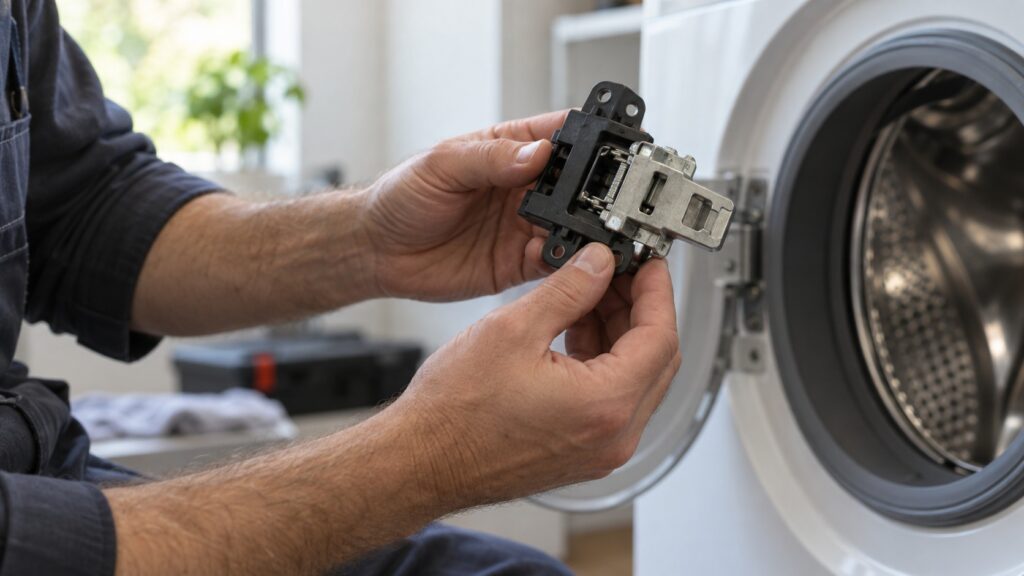
Most calls about a Kenmore washer door problem end up needing one of two small parts, not a new control board. The kenmore washer door latch and lock parts that fail most often are the striker on the door itself, the catch or lock assembly built into the cabinet, and the small switch that reports back to the control that the door is secure. Knowing which of these three is actually at fault before you order anything saves a second trip and a returned part.
What does the door latch on a Kenmore washer actually do?
A front-load washer’s door has to do two separate jobs at once: hold itself shut against water pressure during the wash, and prove to the control board that it is doing so before the drum is allowed to spin. The striker and catch handle the first job — a simple mechanical hook that keeps the door from swinging open. The lock switch handles the second job, an electrical signal that has nothing to do with whether the door is physically shut and everything to do with whether the control believes it is. A washer can have a door that is mechanically perfectly secure and still refuse to run, because the switch that is supposed to confirm that has failed.
How do you tell the striker from the switch?
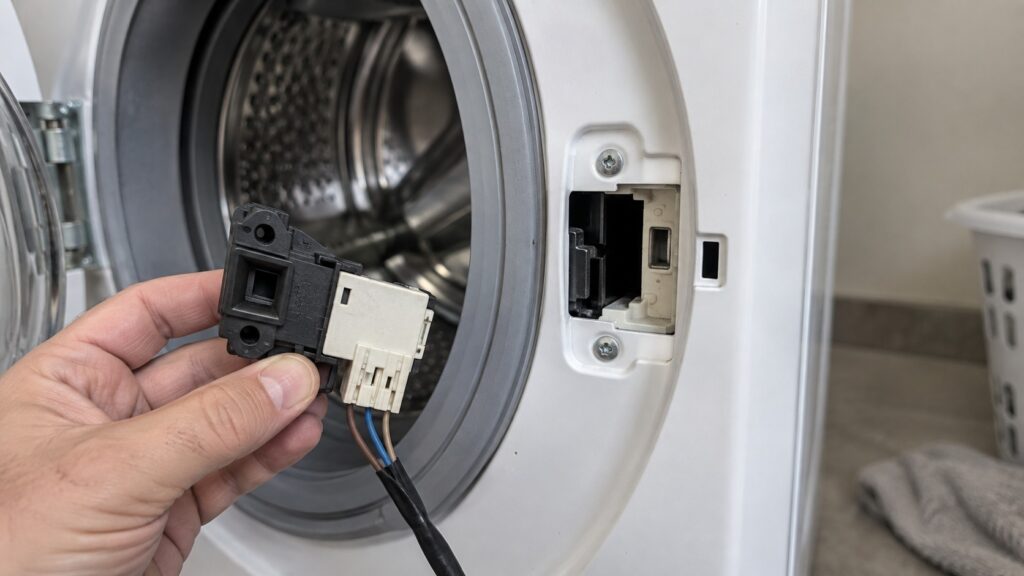
With the washer unplugged, open the door and look at the edge that meets the cabinet. The striker is the small plastic or metal tongue projecting from the door; the catch it enters sits in the cabinet frame and usually contains the switch inside its housing. A striker problem shows itself as a visible defect — a crack, a rounded edge, a loose fitting where it should be rigid, or a strike that clearly sits low or high against the slot because the door has dropped on its hinges. A switch problem shows no visible defect at all: the door closes and the latch feels correct, but the washer still reports a lock fault, because the mechanical half of the job succeeded while the electrical half did not.
What causes these parts to wear out?
On the LG-built 795 and 796-prefix Kenmore and Kenmore Elite washers, the lock assembly typically uses a small wax motor: a heating element that expands a wax pellet to drive the lock closed. That heating element has a finite number of cycles in it, and as it weakens the lock stops driving fully home even though the motor still runs. That failure pattern produces exactly the “door closed but not locking” symptom described in our Kenmore washer dE2 code guide, while a striker that never registers as closed at all points back to dE1 instead. Whirlpool-built 110-prefix washers use a different lock design and a different code scheme entirely, so confirming which factory built your machine before ordering a part matters as much here as it does for the error code itself.
Lint and detergent residue packed into the catch is the single most common non-part cause of a lock complaint, because it prevents the striker from seating squarely even when every part is in good condition. A quarterly wipe of the catch recess with a soft brush costs nothing and rules this out before any part is ordered.
What does it cost to replace a door lock part?
A door lock switch is one of the least expensive parts in the entire machine, and the labor to reach it is modest since the door assembly on most Kenmore front-loaders comes apart from the front without removing the top or the cabinet sides. The full latch or lock assembly costs more than the switch alone but is still a routine part, not a specialty order. A door striker is inexpensive on its own, though it is sometimes sold only as part of the door itself on certain model years, which changes the cost picture. Pricing always starts from a diagnostic visit and is confirmed before any work begins — we do not quote a flat number for a part sight-unseen, because the wrong one of these three parts ordered on a guess is the most common reason a first repair attempt does not fix the problem.
Can you test the lock switch yourself?
With the washer unplugged and the door assembly accessible, a continuity check across the switch terminals with a multimeter, comparing the reading with the door open against the door manually held shut, is the standard test. A switch that shows continuity in only one of those two states, or no continuity in either, has failed. This test involves working near a water-facing seal and inside the cabinet’s front panel, and stopping there and handing the rest to a technician is the right call if you are not confident opening the front panel without disturbing the boot seal’s clamp.
When is a part swap not the right fix?
If the door has visibly dropped on its hinges, replacing the striker or the switch without also correcting the hinge alignment means the new part fails the same way within weeks. If the fault is intermittent rather than constant, chafed wiring in the harness is more likely than any single part, and that calls for a wiring inspection rather than a parts swap. And if the washer was recently moved, check that transit did not knock the door frame out of square before assuming any part has failed at all — our washer installation guide covers the leveling that keeps a relocated machine’s door square.
We are an independent repair company and not a factory service arm. Pricing starts from a diagnostic visit and we confirm the estimate before any work begins. Kenmore washer repair covers door locks, drainage, drive and controls, and you can schedule a visit online.