A front-load washer that pauses early and shows dE2 is not the same fault as dE1, even though both names look almost identical on the display. The kenmore washer de2 code means the door is fully closed, but the lock mechanism never confirmed that it engaged — the opposite half of the same safety check. This code is a verified LG code and appears on LG-built Kenmore washers, the 795 and 796-prefix models sold as Kenmore and Kenmore Elite front-loaders, and it behaves differently from the door-lock codes you may have read about on a Whirlpool-built machine.
What does dE2 mean on a Kenmore washer?
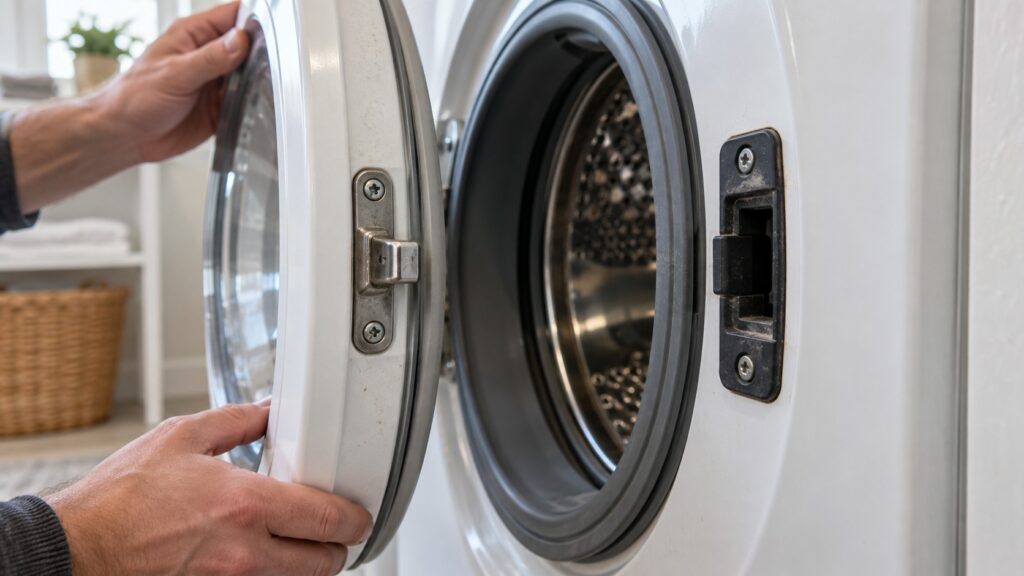
On the LG-built platform, dE2 is raised by the control board when it sends the signal to lock the door and never receives the switch signal back saying the lock engaged. The door itself can look and feel closed — you can push on it and get no give — while the small latch mechanism inside has not physically rotated into the locked position. That distinction matters because it tells you the problem is almost never the door panel or the hinges; it is the latch and the switch that reports on it.
This is different from dE1, which fires earlier in the sequence and means the washer never registered the door as closed at all, usually because of laundry caught in the boot seal or a door that was not pushed shut firmly. If your Kenmore washer dE1 code guide already ruled out an open or obstructed door, dE2 is the next code family to check.
Why do only some Kenmore washers show this code?
Kenmore has never manufactured its own washers. The 795 and 796-prefix front-loaders are built by LG, while the 110-prefix top-load and front-load machines are built by Whirlpool, and each factory writes its own diagnostic codes into its own control board. A Whirlpool-built Kenmore washer does not use dE1 or dE2 at all — it reports door and lock problems through a different scheme entirely. Reading the model tag inside the door frame, or on the rear panel of a top-loader, is the fastest way to confirm which platform you actually own before you spend time on a code that does not apply. Our Kenmore model number decoder walks through where the tag sits and what the first three digits reveal.
What causes the door to close but not lock?
Two mechanical explanations account for most dE2 calls. The first is a latch mechanism that is not fully engaging even though the door has swung shut — the striker on the door edge is not seating cleanly in the catch, often because of a buildup of lint and detergent residue in the catch itself, or because the door has dropped slightly on its hinges after years of use. The second is a worn or failed door lock switch: the latch is doing its job, but the small switch that reports “locked” back to the control has stopped closing reliably, so the washer sees a door that, as far as the electronics are concerned, never locked.
A loose or corroded connector on the wiring harness between the door assembly and the control board produces the same symptom intermittently — the washer locks and runs for several loads, then fails once, then works again. Intermittent behavior is the strongest clue that the fault is in the switch or the wiring rather than the latch itself.
What should you check before calling for service?
- Open and firmly reclose the door. Push until you hear or feel a distinct click, not a light push that lets the door bounce back slightly.
- Clean the latch catch. With the washer unplugged, look at the recess in the cabinet frame that the door’s striker enters, and clear out any lint or soap residue with a soft brush.
- Check for a dropped door. If the striker sits noticeably low or high against the catch, the hinges need adjustment before anything electrical is worth testing.
- Power-cycle the washer. Unplug it or switch off the breaker for two full minutes, then restart a short cycle on an empty drum and listen for the lock.
- Note whether it is constant or intermittent. A code that returns every single time points at the latch or switch; a code that comes and goes points at wiring.
Which part usually needs to be replaced?
When the checks above do not clear the code, the door lock switch is the part most often replaced, since it is a low-cost, well-understood component that simply wears out with the number of cycles the washer has run. The latch and striker assembly is the second most common replacement, particularly on a machine where the door has visibly dropped or where the striker shows wear at its edges. A full control board replacement is rarely the answer and should be the last thing considered, only after the latch, the switch and the wiring have all been ruled out. Our Kenmore washer door latch and lock parts guide covers what each of these parts does and what it costs to have one replaced.
When should you call a technician instead of continuing to test?
Call for service if the code returns immediately on an empty drum with a latch that looks clean and undamaged, if the lock does not audibly engage at all when a cycle starts, or if the fault is intermittent in a way that points at chafed wiring inside the door harness. Do not attempt to run the washer with the door lock defeated or bypassed in any way — the interlock exists because a front-loader that spins with an unsecured door is a genuine safety hazard, not a formality.
We are an independent repair company and not a factory service arm. Pricing starts from a diagnostic visit and we confirm the estimate before any work begins. Kenmore washer repair covers door locks, drainage, drive and controls on both LG-built and Whirlpool-built machines, and you can schedule a visit online.