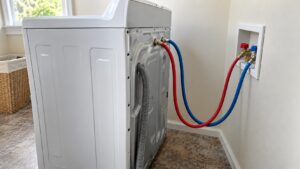
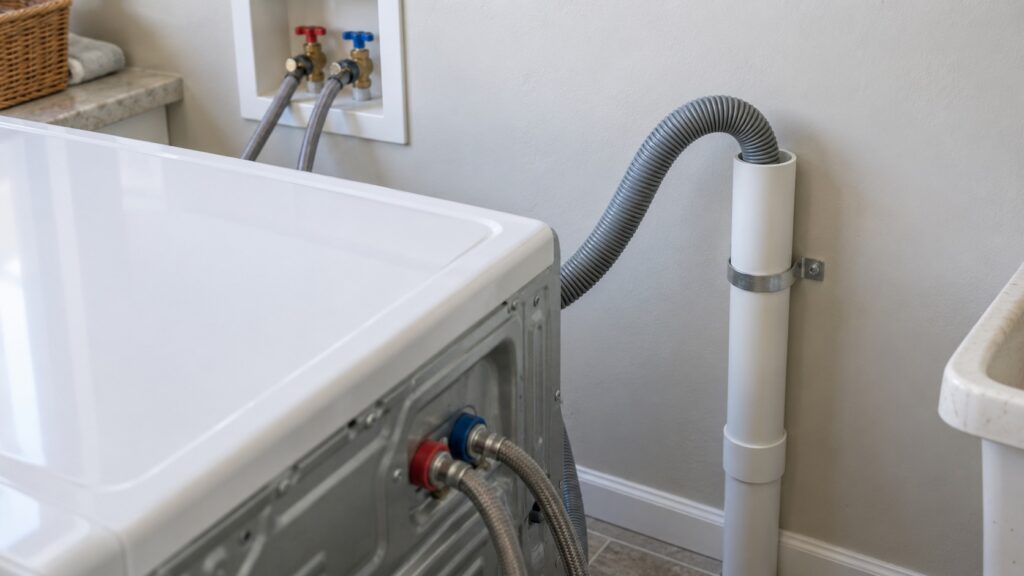
A Kenmore washer drain hose is set up correctly when it runs from the back of the washer to a standpipe or utility sink without kinks, rises to the height your installation sheet specifies, enters the pipe only a few inches and is not sealed tight around the opening. Our Kenmore washer installation guide says the drain hose should empty into a standpipe sitting between roughly 30 and 96 inches off the floor per most manufacturer installation instructions, with the hose inserted no more than a few inches to keep an air gap and prevent siphoning. The exact figures for your model are in its installation instructions. This guide explains why each detail matters and how to check an installation someone else made.
How should a Kenmore washer drain hose be connected?
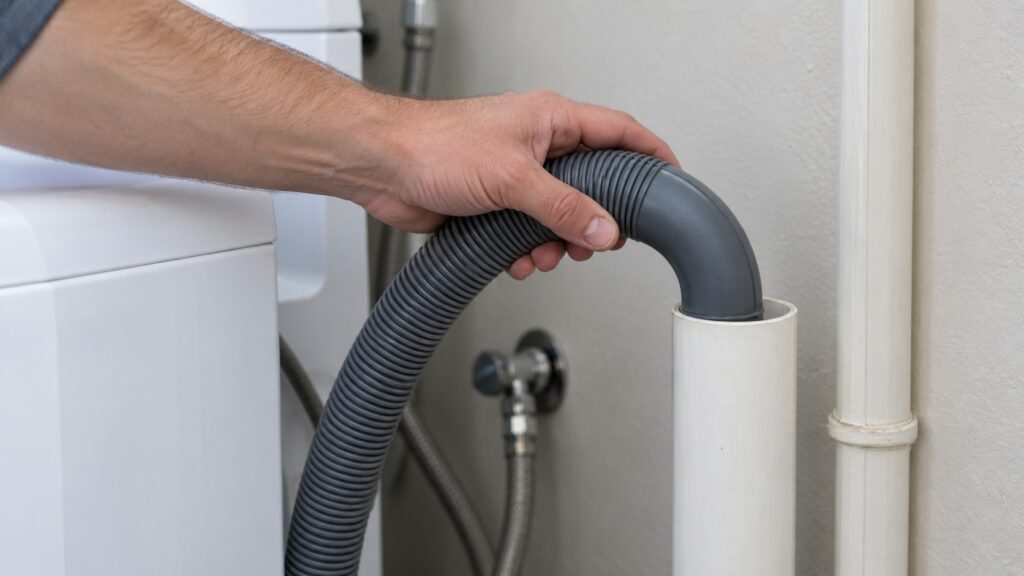
The drain hose carries the used water from the washer’s drain pump out to the house drain. It leaves the back of the washer and goes up and over into a standpipe, a vertical pipe connected to the household drain, or into a utility sink drain where the instructions allow it. The shape matters. Our installation guide says the hose goes into the standpipe only a few inches and is not pushed down it. Many washers ship with a hose guide or a plastic elbow that holds the end in a curve, and your installation sheet shows how to use it. Do not stretch the hose tight and do not run it so that it is pinched by the washer’s back panel or a cabinet.
How high should the standpipe be?
Our guide says the standpipe should sit between roughly 30 and 96 inches off the floor, per most manufacturer installation instructions, and warns that a standpipe that is too short or too tall can cause the washer to drain poorly or siphon water continuously during the wash. That range comes from our installation guide, not from your washer’s own sheet, and it is not the same for every model. Read the installation instructions that came with your washer or are listed for your model number. If you are not sure how high your pipe is, measure from the floor to the top of the pipe, and do not move or cut a drain pipe yourself; that is a plumber’s job.
Why does the air gap matter?
If the hose is pushed far down the pipe, or sealed tight around it with tape or a cloth, the drain can pull water backward during the wash. That is called siphoning: the washer drains continuously, and the tub never holds the water it needs, so wash results are poor and the drain pump labors. Our guide says the hose should be inserted no more than a few inches to maintain a proper air gap. A hose that fits loosely in the pipe is correct. A hose sealed tight is not, even if it looks tidy.
What problems does a poor drain setup cause?
Our installation guide says a poorly installed standpipe is a preventable cause of drain complaints. The signs are water pooling in the tub after a cycle, a washer that drains too slowly or too fast, water overflowing the standpipe, a damp smell and gurgling from the pipe. Our Kenmore washer not draining guide lists the physical checks that apply whatever built the machine: a kinked or crushed drain hose, a clogged pump filter, a blocked standpipe or sink connection and, last, a failing drain pump. Start with the hose and the pipe, because those checks cost nothing. On an LG-built washer, the guide says a real drain failure shows as an OE code, covered in our oE code guide.
How do you check an existing installation?
- Switch the washer off at its breaker and pull it forward only as far as the hoses allow, or look behind it with a light. Do not strain the supply hoses.
- Look along the drain hose for kinks, crushing and cracks, from the washer to the pipe.
- Check that the hose end enters the pipe only a short way, that it is held in place and that nothing is sealed around it.
- Check that the standpipe is not blocked and drains freely.
- Run a rinse and spin and watch the pipe for gurgling or overflow.
Our Kenmore washer installation guide covers the rest of the setup: new supply hoses, hot to hot and cold to cold, shipping bolts removed and the washer leveled. If water appears on the floor, stop the washer, close both shutoff valves and switch off the breaker while standing on a dry floor.
A few small habits keep the setup working. Re-check the hose position after any move or deep clean of the laundry area, because a hose that has slipped lower into the pipe or been bent by a pulled-out washer is the usual way a good installation goes bad. Keep the standpipe free of lint and debris, and if the washer is installed next to a utility sink, keep the hose tied or guided so it cannot flop into the sink water, which can also siphon.
When should you call a professional?
Call when your installation involves relocating water lines or adding a standpipe, when the pipe height is outside the range in your instructions, when the washer still drains poorly after the hose and pipe check or when you are not confident about the work. Standpipes and house drains are plumbing, and the pump is the washer’s own part. Our Kenmore washer repair technicians handle installations as well as repairs, and you can schedule a visit online with your model number ready. We are an independent repair company, not the manufacturer.