TL;DR: A Kenmore appliance tripping the breaker is telling you that too much current is flowing, or that current is escaping where it should not. Three causes cover almost every case: a circuit shared with other loads, a part in the appliance drawing too much current, and a short to ground. The timing of the trip is your best clue. Unplug the appliance, reset the breaker once, and if it holds, the problem is in the appliance. If it trips again, stop and call for service.
Why does an appliance trip a breaker?
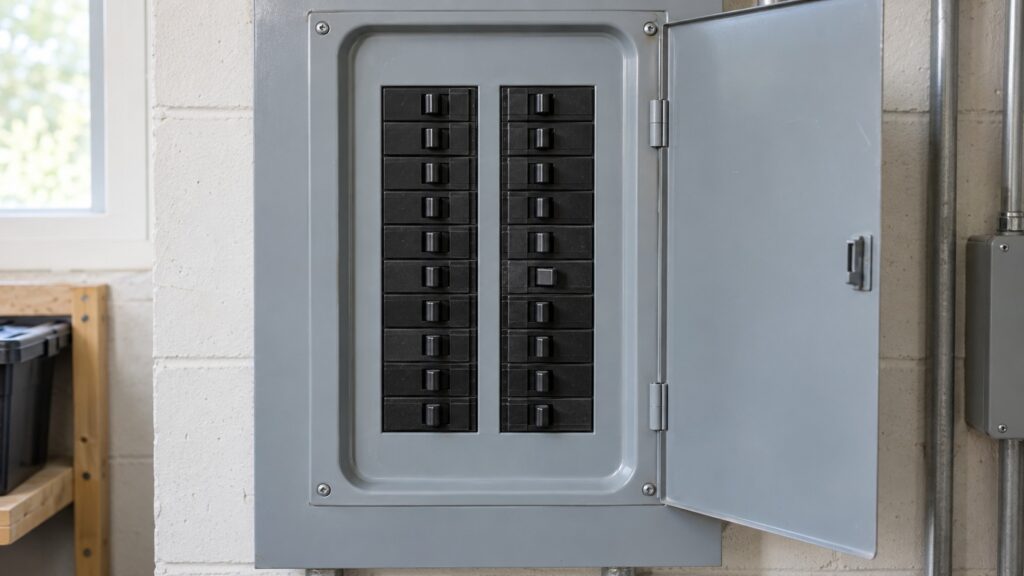
A breaker is a safety device. It opens the circuit when current rises above what the wiring can carry, or when current leaks to ground. A single trip after a power surge or a one-off overload is not unusual. A trip that repeats, especially at the same moment in the appliance’s cycle, means something real is going on. Resetting the breaker over and over does not fix that; it only makes the wiring and the appliance work against the protection you are relying on.
Because Kenmore appliances are built by different manufacturers, the parts that fail differ from model to model, but the electrical logic is the same for all of them. Our guide to reading a Kenmore model number helps you identify what you have before you describe the problem.
What does the timing of the trip tell you?
Watch for the moment. If the breaker trips as soon as you plug the appliance in, or as soon as you turn the breaker on with it connected, the fault is present all the time, which points to a short in the cord, the plug or the wiring. If it trips when the heat comes on, as in a dryer or oven, a heating element or its wiring is the suspect. If it trips when a motor starts, as when a washer spins up or a refrigerator compressor kicks on, look at the motor, the pump or the compressor start parts. If it trips only when something else on the circuit is running, the circuit is overloaded, and the appliance may be perfectly healthy. Write down what happened, and in what order, before you touch anything else.
What can you safely check yourself?
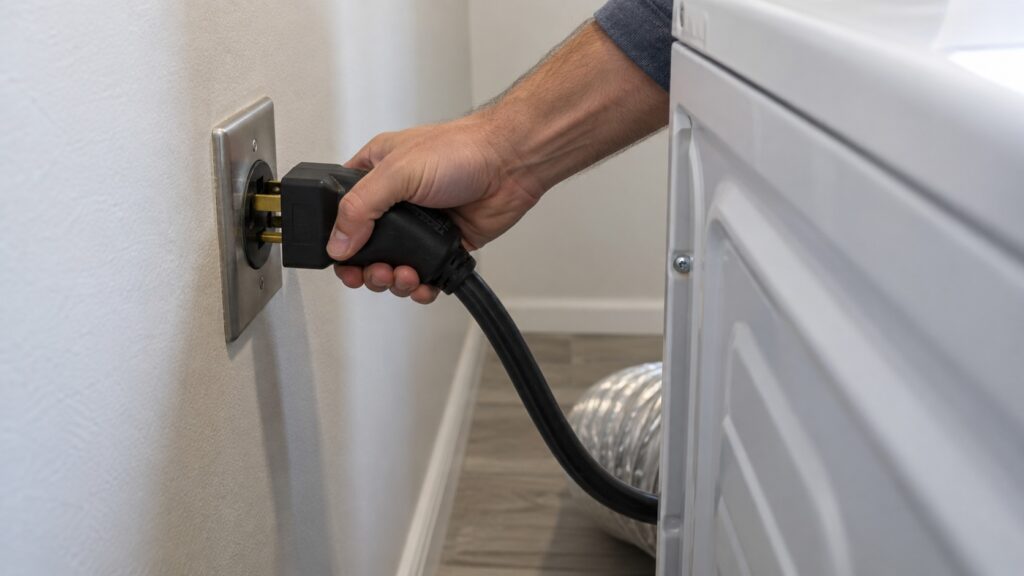
- Unplug the appliance. Pull the plug, or for a hardwired unit leave it to a professional. Reset the breaker once. If it trips with nothing connected, the problem is in the house wiring or the breaker and an electrician should look at it.
- Look at the cord and plug. Check for scorch marks, melted plastic, a loose fit in the outlet or a cord pinched behind the appliance. Do not use a unit with damaged insulation.
- Check what else shares the circuit. A window air conditioner, a space heater or a microwave on the same circuit can tip a laundry or kitchen circuit over.
- Look for moisture. A leak onto an appliance, or condensation at an outdoor outlet, can trip a breaker intermittently.
- Plug back in and test once. If the breaker trips again, stop. Leave it unplugged.
Never open the cabinet to probe wiring, never bypass a breaker and never swap in a larger one. Those steps turn a nuisance into a fire risk.
How does this show up on a dryer, range, washer or refrigerator?
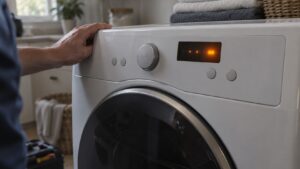
A dryer and a range use 240-volt circuits with large breakers, and a trip when the heat starts usually points at the element or a short in the heater circuit; a trip when the drum starts points at the motor. A washer that trips as it fills or spins may have water reaching wiring or a failing pump motor. A refrigerator that trips only when the compressor starts may have a worn start component. If a dryer will not start at all and you suspect the breaker, see dryer won’t start, and if it runs but does not heat, dryer not heating. For fixed installations, the dryer installation and range installation guides explain the circuit each appliance needs.
Could the breaker itself be the problem?
Sometimes. Breakers age, and an old one can trip below its rating or fail to hold a reset. Signs include a breaker that feels warm or loose, trips with nothing plugged in, or trips at random times of day. A ground-fault protected circuit, found in kitchens, laundry areas and garages, also trips on small leakage that an ordinary breaker would ignore, such as a little moisture in a cord. Replacing a breaker or a protected outlet is electrician’s work. It is worth ruling out before you spend on an appliance part, because a perfectly good dryer or refrigerator can be blamed for a fault in the panel.
When should you stop and call?
Stop when the breaker trips more than once, when you see scorching or smell burning, when the cord or outlet is warm, or when the appliance trips the breaker the moment it is plugged in. Leave it unplugged and the breaker off. A technician can test the heating element, the motor and the wiring with a meter, and an electrician should look at a circuit that trips with nothing plugged in. Our Kenmore dryer repair and range repair pages describe what a visit includes, and you can book a visit with your notes on the timing.