When a kenmore dryer won’t start there is a specific order to check things in, and it is not the order most people use. Almost everyone reaches for the control panel first. In practice the fault is usually in one of three places — power, the door, or the start circuit — and working through them in that sequence resolves a large share of these calls without any parts at all.
Start with power, properly
An electric dryer runs on a 240-volt supply made up of two legs. If one leg fails — a tripped half of a double breaker, a loose connection in the outlet, a failed fuse in older installations — the dryer can behave in confusing ways: the drum turns but there is no heat, or the panel is completely dark while the outlet still tests live on one side.
Check the breaker by switching it fully off and then on again rather than just looking at it, because a tripped double breaker does not always sit visibly out of line. Then check the cord where it enters the dryer: the terminal block screws work loose over years of vibration, and a loose neutral produces exactly these symptoms.
A gas dryer has the same failure in miniature — it runs on ordinary household voltage, so a tripped breaker or an outlet that has failed will leave it dead.
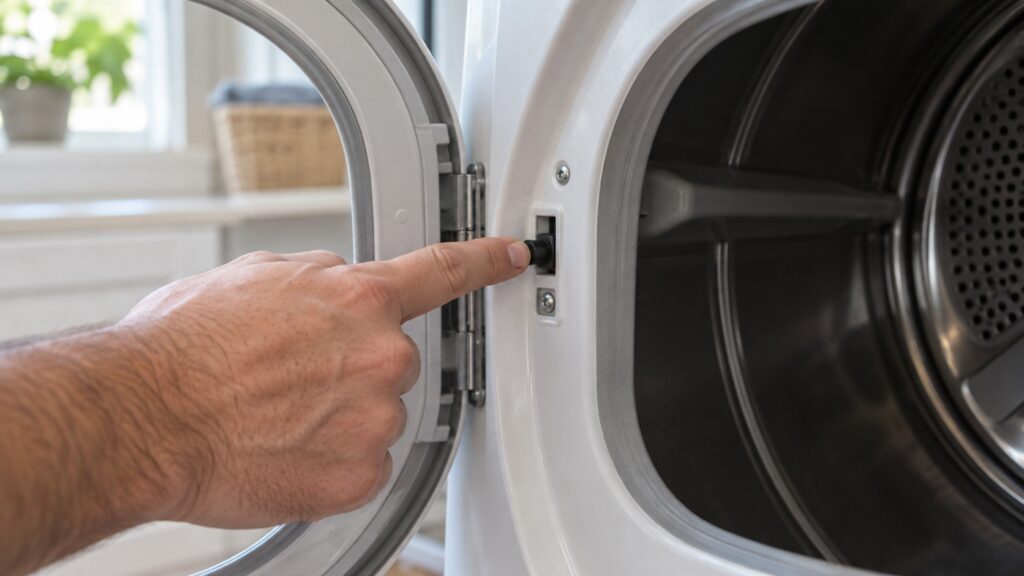
The door switch, which fails more than anything else
A dryer will not start with the door open, and it decides that through a small switch in the door frame that the door presses as it closes. That switch is operated thousands of times, and it wears.
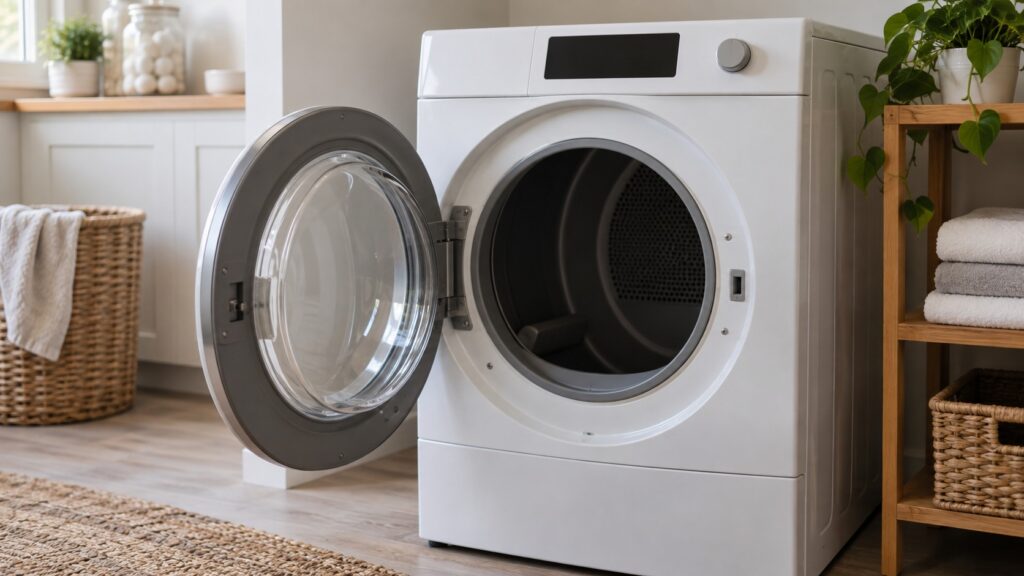
Test it by ear. Open the door and press the switch plunger with a finger — you should hear a distinct click. Press it several times and listen for the click being inconsistent. Then close the door and check that it actually latches; a door that no longer sits flush, or a strike that has worn, will not press the switch far enough.
The clue that points here is a dryer whose light and panel work perfectly but which does nothing when you press start. From the control’s point of view, the door is open and everything is behaving correctly.
The start switch and the control
If the door circuit is good, the next candidate is the start switch itself. These are momentary switches and they fail by no longer making contact, usually gradually — people report having to press harder, or press twice, for weeks before it stops entirely.
A control board fault is possible but it belongs later in the list, not earlier. Before suspecting it, unplug the dryer for five minutes to let the control reset fully; a surprising number of unresponsive panels come back after a proper power cycle, and a quick off-on is not the same thing.
If the dryer shows a code rather than simply doing nothing, that is more useful information than silence. Our PF code guide covers the power failure code specifically, and the D90 and D95 guide covers airflow codes.
When it hums but will not turn
A hum means the motor is receiving power and cannot turn. Two things produce that. Either the drum is physically obstructed — a garment jammed between the drum and the bulkhead, or a drum that has dropped onto a failed roller — or the motor’s start winding circuit has failed.
Test the first with the power off: reach in and turn the drum by hand. It should turn with moderate, even resistance. If it is locked solid, or grinds, that is mechanical and no amount of pressing start will help.
If it turns freely and the motor still only hums, the motor or its start components need attention. Do not keep pressing start — repeated attempts with a stalled motor is how the windings get cooked, and that turns a repairable fault into a motor replacement.
When it starts and then stops
A dryer that runs for a few minutes and shuts off, then refuses to restart until it has cooled, is showing you thermal protection doing its job. The motor has a thermal cutout that opens when it overheats, and it resets itself once cool.
The usual reason a motor overheats is that it is working too hard, and the usual reason for that is restricted airflow. A blocked lint filter, a crushed transition duct or a vent run packed with lint makes the motor and the blower labor continuously. Our multiple cycles guide covers the airflow side, which is the same root cause behind clothes that never quite dry.
Failing bearings and worn drum rollers also raise the load enough to trigger this, and they usually announce themselves with noise before they announce themselves with cutouts.
What to check in order
- Breaker off and on, both halves, and test the outlet.
- Terminal block at the back of the dryer for loose screws — power off first.
- Door switch by ear, several times, and the door latch for a clean close.
- Five-minute power cycle to reset the control fully.
- Turn the drum by hand with the power off.
- Lint filter and vent, if it runs briefly and cuts out.
When to call
Call when the dryer is dead with a confirmed live outlet, when the motor hums with a freely turning drum, when the drum will not turn by hand, when the control is unresponsive after a proper reset, or when the machine cuts out repeatedly with a clear vent.
We are an independent repair company and not a factory service arm. Pricing starts from a diagnostic visit and we confirm the estimate before any work begins. Kenmore dryer repair covers motors, switches, heating and controls, and you can schedule a visit online.