Kenmore oven temperature calibration is a two-part job: first measure how far off the oven really is with a separate oven thermometer, then enter the difference in the control’s temperature adjustment setting. Most electronic Kenmore ovens let you shift the temperature by up to about 35 degrees F in either direction. The exact keystrokes differ by model and by builder, so your use and care guide has the final word. If the oven is more than 35 degrees off, or the temperature swings wildly, calibration will not fix it, because a sensor or a control is failing.
How do you know a Kenmore oven needs calibrating?
The signs are practical. Cookies brown faster than the recipe says, a roast takes much longer than it should, a cake is pale in the middle or a pie crust burns while the center is raw. If one recipe goes wrong, the recipe may be at fault. If everything you bake drifts in the same direction, the oven is probably reading off.
Do not assume it is the calibration, though. Uneven results from side to side or front to back point to a heating problem and not an offset. Our guides to a Kenmore oven not heating evenly and oven not heating diagnostics cover those cases. Calibration shifts the whole temperature up or down. It cannot fix a hot spot.
How do you test the real temperature?
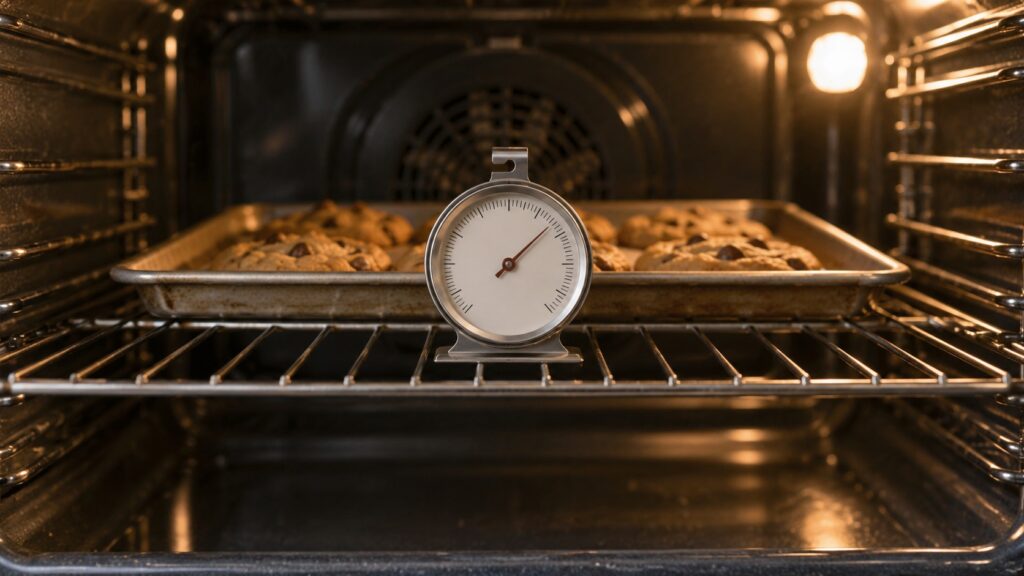
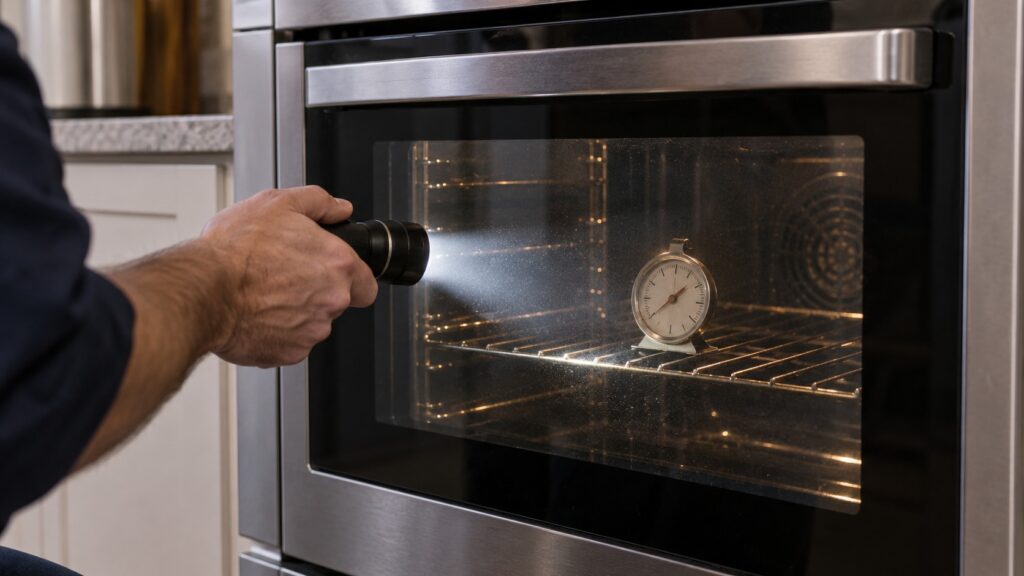
Buy an inexpensive oven thermometer that hangs from or stands on a rack, since no other tool is needed. Then:
- Place the thermometer on the center rack, in the middle of the oven, away from the walls and the door.
- Preheat to 350°F and wait for the oven to signal that it has finished preheating.
- Wait another ten to twenty minutes. The oven’s first signal is early, and the cavity needs time to even out.
- Read the thermometer through the window, without opening the door more than necessary. Look several times over about twenty minutes and note the high and the low.
- Average the readings. Ovens cycle the element on and off, so the temperature swings above and below the setting. A swing of 10 to 25 degrees is normal.
If the average sits within about 15 degrees of 350, the oven is behaving normally and does not need adjusting. If it sits 20 degrees or more above or below, an adjustment is worthwhile.
How do you enter the adjustment on a Kenmore oven?
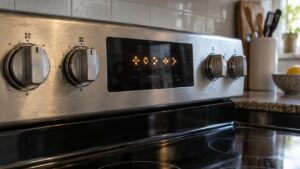
Electronic Kenmore ovens have a hidden setting for this. The usual pattern is a press and hold of the Bake key, or of another key combination listed in your manual, for several seconds until the display shows an offset number. You then raise or lower it with the temperature keys and press Start or Bake to save it.
Because Kenmore ovens come from different builders, the exact steps differ. Look up the first three digits of your model number, read the calibration section of the matching manual and follow it exactly. If you are not sure who built your oven, our guide to Kenmore oven error codes by builder lists the common prefixes.
A few rules apply to all of them:
- Adjust by the amount you measured, and not by a guess. If the oven runs 25 degrees cool, raise the offset by 25.
- Make one change at a time. Then repeat the thermometer test to confirm that it worked.
- Write the change in your manual or on a note inside a cabinet. A power cut or a board replacement can reset it.
- Older ovens with a mechanical thermostat knob are adjusted differently, and that involves removing the knob. Leave it to a technician unless your manual walks you through it.
What if calibration does not fix the problem?
If the offset hits its limit before the oven reads correctly, or the temperature swings far more than 25 degrees, the oven has a hardware fault. The usual cause is the oven temperature sensor, a thin probe in the cavity that tells the control how hot the oven is. A sensor that drifts reports the wrong temperature, and the control then heats to the wrong target. A worn bake element, a failing relay or a control board fault can also produce the same result.
Some of these show up as a code. On our site, F3E0 and F3E1 describe a Whirlpool-built oven’s temperature sensor as open or shorted, and F30 and F31 describe the probe on a Frigidaire-built oven. See our guides on Kenmore oven F3E0 and F3E1 and Kenmore F30 and F31. Do not touch the sensor or an element yourself: the oven runs on a 240-volt supply, and the cavity stays hot long after you switch it off.
When should you call a technician?
Call if the oven is more than 35 degrees off, if the offset will not hold, if the temperature swings widely, or if a temperature code appears. Our Kenmore oven repair technicians measure the actual temperature, test the sensor and the element and tell you whether a part or a calibration is the answer. We are an independent repair company, not a factory service arm, and we will tell you when a repair is not worth doing. You can book a visit and bring your thermometer readings.