An oven that will not heat at all is a different problem from one that heats unevenly, and it deserves a different set of checks. Kenmore oven not heating diagnostics start with a question the display cannot answer for you: is the oven trying to heat and failing, or is it not trying at all? Answering that with a few minutes of listening and one multimeter check points you at the igniter, the bake element, or the temperature sensor before you order any part.
Is the oven trying to heat, or not responding at all?
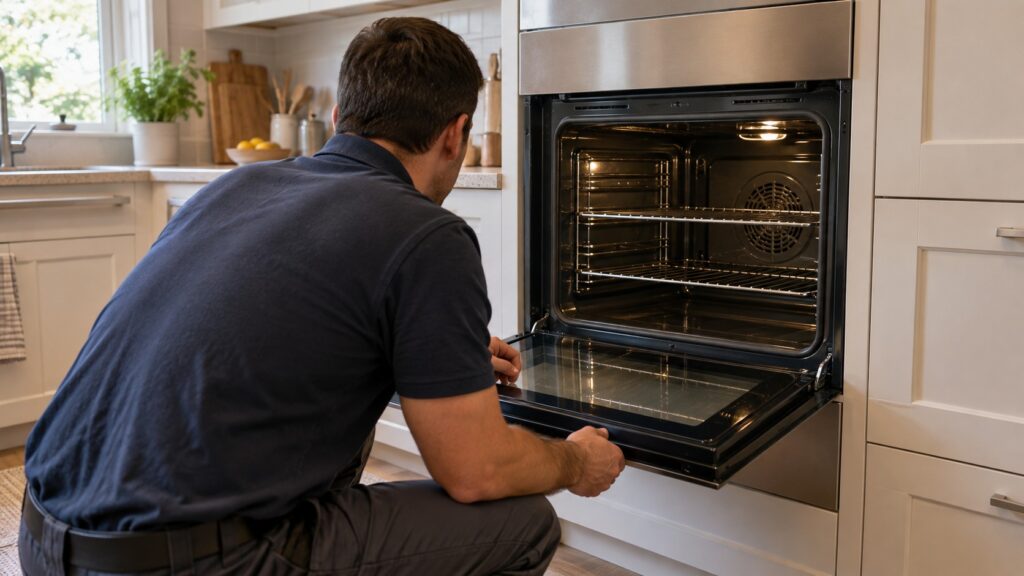
Set the oven to bake at 350°F and stand where you can both see the cavity and hear the burner area, then time what happens over the next two minutes. A gas Kenmore oven should click as the igniter starts, glow briefly, and settle into a steady hiss as the burner lights. An electric oven’s bake element, visible through the door on most models, should begin to glow orange within roughly ninety seconds to two minutes. If you see or hear nothing at all — no click, no glow, no fan — the fault is more likely in power delivery to the oven or in the control board itself. If you hear the igniter clicking repeatedly without the burner ever lighting, or see the element attempt to glow and then shut off, the fault is downstream in the burner or element circuit, and that is a meaningfully different repair.
What does the display tell you before you open anything?
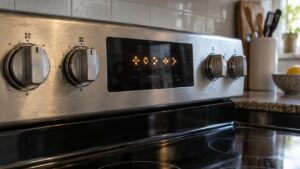
Check for a fault code before doing any physical test. A wall oven showing F3E0 or F3E1 is reporting an open or shorted temperature sensor circuit specifically, which is a different repair from a dead igniter or a burned-out element, even though both can present as “the oven will not heat.” A code takes you straight to the failed component; the absence of a code means the fault is more likely mechanical — an element, an igniter, or a gas valve — rather than a sensor reporting bad data to a control that is otherwise working correctly.
How do you test a bake element without a code?
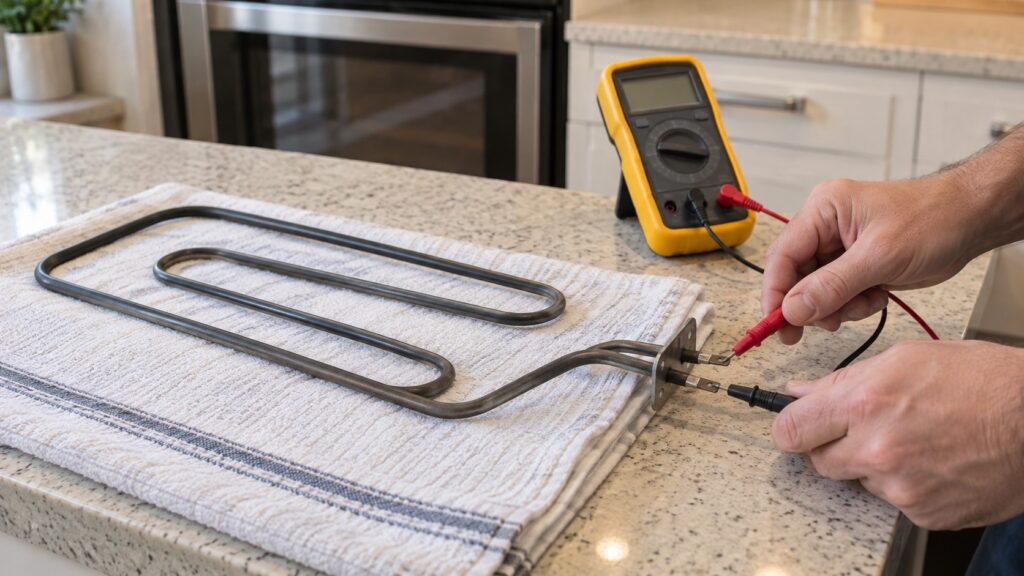
With the oven unplugged or the breaker off, and the element accessible from inside the cavity, disconnect the element’s wire terminals and set a multimeter to resistance. A functioning bake element typically reads somewhere between roughly 20 and 60 ohms depending on wattage; an open element reads infinite resistance and needs replacing. A visible break, blister, or bulge in the element’s metal sheath is often visible without a meter at all — inspect the full length before assuming the fault is electrical rather than mechanical damage from a spill or a rack scraping against it.
On a gas oven, the same logic applies to the igniter rather than the element. A weak igniter draws current and glows but does not get hot enough to open the gas safety valve, so you hear repeated clicking and smell gas only briefly before the system shuts itself down as a safety measure. That pattern points squarely at the igniter, which is a routine, well-understood part.
What if the oven heats, but shuts off early or cycles oddly?
An oven that heats correctly for a few minutes and then shuts off before reaching temperature, rather than one that never heats at all, usually points at the temperature sensor reporting an incorrect reading rather than at the element or igniter — the control believes the target temperature was reached when it was not. That is a different diagnostic path from a total no-heat complaint, and it is worth separating the two clearly before ordering any part, since a sensor and an element are not interchangeable and neither fixes the other’s fault.
What should you check before assuming a part has failed?
- Confirm the breaker or gas supply. A tripped breaker on one leg of a 240-volt electric oven can leave the oven partly powered — lights and a fan work, but the element never gets full voltage.
- Check the door is closing fully and that nothing is holding the door switch in the open position, which some models use to interrupt heating as a safety measure.
- Rule out a control lockout. A self-clean cycle that ended improperly can leave the door lock engaged and heating disabled until the control resets.
- Look for a fault code first, every time — it is the fastest way to skip straight to the failed component.
Does a convection fan change the diagnosis?
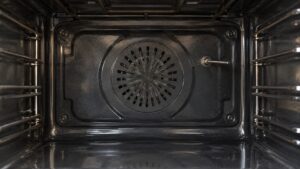
On a Kenmore oven with a convection fan, a no-heat complaint sometimes turns out to be a fan that has failed rather than the element or igniter at all — the burner or element lights normally, but the fan that is supposed to circulate that heat evenly never starts, so the cavity heats slowly and unevenly enough to feel like a heating failure from the outside. Listen for the fan specifically, separate from the burner or element sound described earlier: a soft, continuous whir behind the rear panel of the cavity. Its absence while the element or burner otherwise behaves normally points at the fan motor rather than at the heating components covered above, and it is worth ruling in or out before any element or igniter is ordered.
A broiler that will not heat while the bake element works fine is diagnosed the same way as the bake circuit, just aimed at the broil element instead — the same continuity test applies, since most Kenmore wall ovens wire the two elements as separate circuits that fail independently of one another.
When should this go to a technician instead?
Any test that requires reaching into the burner area, the igniter assembly, or an element while the oven could still be live belongs with a technician, not a multimeter in an oven that is still plugged in. Gas work in particular — a valve that opens without ignition, or a persistent smell of gas — is a stop-and-call situation, not a DIY check. Our Kenmore oven parts guide covers what a replacement element, igniter, or sensor typically involves once the diagnosis above has pointed at one of them.
We are an independent repair company and not a factory service arm. Pricing starts from a diagnostic visit and we confirm the estimate before any work begins. Kenmore oven repair covers doors, hinges, seals, heating and controls, and you can schedule a visit online.