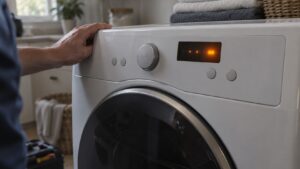
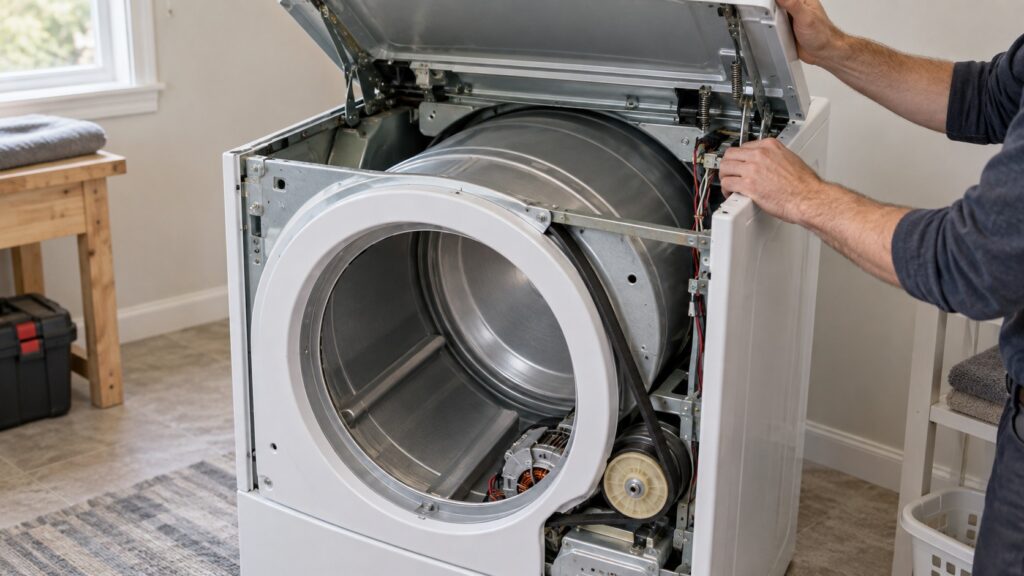
TL;DR: Four parts move and carry the drum of a Kenmore dryer: a drive belt wrapped around the drum, an idler pulley that keeps the belt tight, support rollers that hold the front of the drum, and a rear bearing or glide that holds the back. When the belt snaps, the motor hums and the drum does not turn. When the pulley or rollers wear, you hear a squeal or a thump that follows the drum. Kenmore dryer belt and rollers repairs mean opening the cabinet, so they are a technician job.
What does each part in the Kenmore dryer drum drive do?
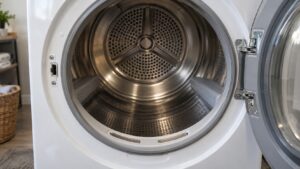
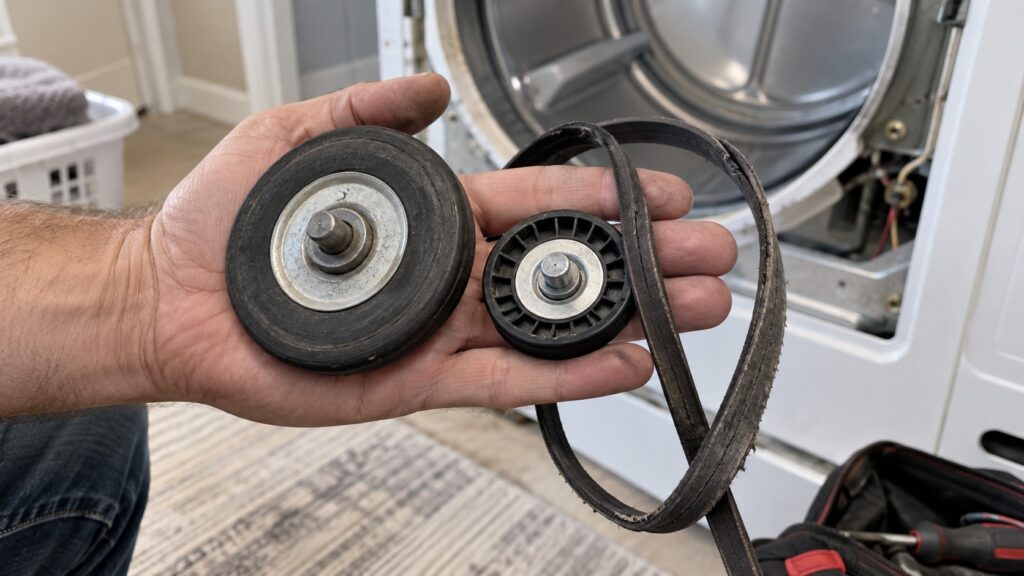
A dryer drum is a big steel cylinder that spins slowly while the motor runs much faster, so the motor does not turn the drum directly. Instead, a long thin belt loops around the drum and around the motor pulley, and an idler pulley on a spring-loaded arm pushes against the belt to keep it taut. Without that tension, the belt slips and the drum labors. The front of the drum sits on two or more support rollers, which let it roll smoothly, and the back rests on a bearing or a glide fitted into the rear panel.
All of those parts wear. Belts stretch and crack. Pulleys and rollers wear their bearings, then start to make noise. The wear is gradual, which is why a dryer can sound a little rough for months before something finally fails.
Which sound or symptom matches which part?
The pattern you hear is the best clue. On our site these are the signs, and the parts they usually mean:
- A squeal that rises and falls with the drum’s speed. A worn idler pulley or worn support rollers.
- A thump once per rotation, worse with a heavy load. Worn drum support rollers or a belt riding unevenly.
- A grinding sound from the rear of the cabinet. A worn rear drum bearing or glide.
- The motor runs and the light comes on, but the drum does not turn. A broken drive belt, or a belt that has come off.
- A burning-rubber smell. Often a recently broken belt, or a belt that has been slipping.
A simple test helps: with the dryer off and unplugged, turn the drum by hand. If it turns freely but does not turn under power, suspect the belt. If it feels rough or catches, the rollers or bearing are suspects.
Why is a broken belt the most common failure?
The belt does the hardest, most repeated work, and heat dries and cracks rubber over time. A belt under load from a heavy wet load, or one that has been slipping because the idler pulley is worn, ages faster. When it finally snaps, the drum stops turning but the motor often keeps running, so the dryer sounds as if it is working and the clothes stay wet. That combination of a humming motor and a still drum is the textbook sign. If you suspect a broken belt, stop running cycles, since continued running does not help and the motor can be strained.
One more clue is the start switch. On some dryers a belt-break switch senses the belt, so a broken belt can make the dryer refuse to start at all, which sends owners looking at the control and the door switch instead. If the dryer will not start and the drum spins freely by hand, mention the belt to the technician along with the other symptoms.
Why should you not ignore a new noise?
A squeal or grind is an early warning. Worn rollers and bearings can progress until the drum comes off its supports, and a drum that drops can tear the belt, damage the rear panel and turn a modest repair into a larger one. If your dryer has started to make a new noise, note when it happens, whether it changes with the load size, and whether it comes and goes with drum rotation. Those details help the technician choose the parts to bring.
Does the dryer’s builder change the parts?
It can. Kenmore dryers are built by different manufacturers: on our site, 110-prefix dryers are Whirlpool-built and 796-prefix dryers are LG-built, and the belt, pulley and roller designs differ between them. That is why replacement parts must be matched to the full model and serial number rather than to the word Kenmore. Our model number decoder and the parts lookup guide show how to find the right match. Mixing parts between families is a common cause of a repair that does not hold.
When should you book a repair?
Book when the drum does not turn, when a squeal or grind persists, or when you smell burning rubber. The technician will confirm the failed part before ordering, which avoids replacing a belt when the real problem is the pulley or rollers behind it. While you wait, keep the lint filter and vent clear; heat and clogging make belts and bearings work harder, and our dryer maintenance guide shows the routine. If the dryer turns but does not heat or start, see dryer not heating or dryer won’t start. The page for Kenmore dryer repair describes the visit, and you can book a visit in minutes.