A front-load washer that stops partway through and shows dE1 is reporting a door problem. The kenmore washer de1 code means the control asked the door to lock, and the feedback it expected never arrived — so it stops, because a front-loader that spins with an unlocked door is a serious hazard. The good news is that the most common causes are things you can check yourself in ten minutes.
Check the simple causes first
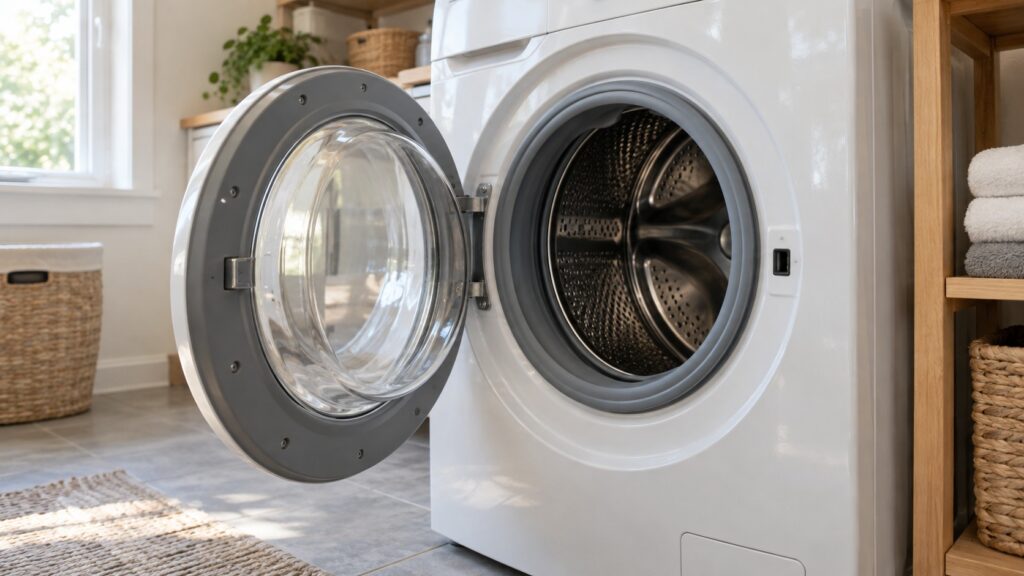
Most dE1 events are not faults. Open the door, look all the way around the seal, and check for a sock, a sleeve or a corner of a duvet caught between the door and the boot. Even a thin item stops the door pulling in the last fraction it needs to latch.
Then look at the load itself. A drum stuffed past its capacity pushes the laundry against the glass, and that pressure alone can be enough to prevent a clean latch. Take out a third of it and try again.
Finally, close the door deliberately — a firm push until you feel it seat, not a swing that lets it bounce. People develop a habit of nudging the door shut, and as the latch wears, that habit stops being enough.
Clear the code and see whether it returns
- Unplug the washer or switch off its breaker, and leave it off for five minutes.
- Restore power and let the control complete its startup without touching anything.
- Start a short cycle with the drum empty and listen for the latch: a distinct click within a second or two of the cycle starting.
- If it locks and runs, the code was a one-off event — often a caught item or a power disturbance.
- If it returns immediately, it is not a stray reading and the next section applies.
Inspect the latch and the strike
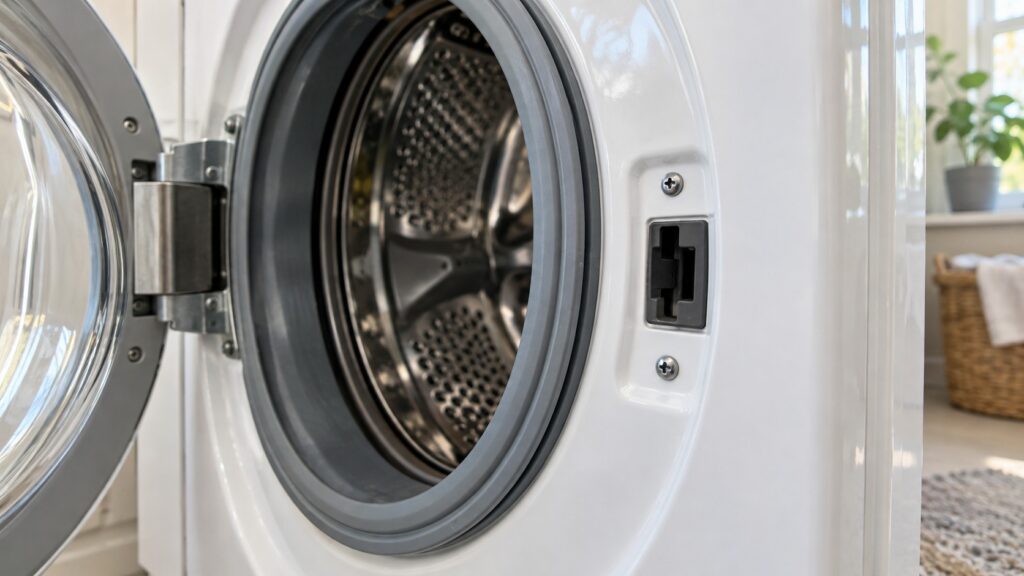
With the power off, look at the two halves of the mechanism. On the door there is a strike — a plastic or metal tongue that projects into the machine. On the cabinet there is the lock assembly, a housing with a slot the strike enters.
What you are looking for: a strike that is cracked, bent or worn round at the edges; a slot packed with lint, detergent residue or a small foreign object; and any sign that the strike is not entering the slot squarely. Clean out the slot with a soft brush, and check that the strike is firmly fixed to the door rather than loose in its mounting.
If the strike sits visibly low against the slot, the door has dropped on its hinges. That is common on a machine whose door gets leaned on or used as a shelf, and it is usually correctable at the hinge rather than by replacing anything.
What the lock assembly actually does
The assembly is two things in one housing. A mechanical catch holds the door shut, and an electrical element — typically a wax motor or a solenoid, plus a switch — physically locks it and reports back to the control that it has done so.
That second half is what fails. A wax motor operates through a heating element that has a finite number of cycles in it, and when it weakens it stops driving the lock fully home. The switch then never closes, the control never gets its confirmation, and you get dE1 on a door that looks and feels perfectly shut.
This is a common, well-understood part replacement rather than a serious repair, and it is usually the answer when the code returns on an empty drum with a clean, undamaged latch.
Less common causes worth knowing
A wiring harness that has chafed where it passes into the door frame will produce an intermittent version of the same code — the machine works for days, then fails, then works again. Intermittency is the clue.
A control board fault can also present this way, but it is the last thing to suspect rather than the first. If the lock audibly operates and the code still appears, that points at the switch or the signal path rather than at the mechanism.
And on a machine that has been moved, check the door has not been knocked out of alignment in transit. Our washer installation guide covers the leveling and seating that a relocated machine needs.
Getting the door open when it is stuck shut
If the machine has stopped mid-cycle with water inside, the door will not open until the water is out — that is by design, not a fault. Drain it through the drain pump filter at the front lower panel, with a shallow tray and towels ready, and the door will usually release once the level drops and the machine is powered down.
Do not lever the door with a tool. A broken door glass or a cracked boot turns a routine part replacement into a much larger job. Our not draining guide covers emptying the machine safely.
When to call
Call when the code returns on an empty drum with a clean latch, when the lock does not operate audibly, when the fault is intermittent in a way that suggests wiring, or when the door is stuck shut with water inside and will not release. Do not run the machine with a latch that has been defeated in any way.
We are an independent repair company and not a factory service arm. Pricing starts from a diagnostic visit and we confirm the estimate before any work begins. Kenmore washer repair covers door locks, drainage, drive and controls, and you can schedule a visit online.