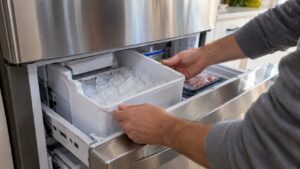
Understanding common Kenmore ice maker parts and what each one actually does makes it much easier to describe a problem accurately to a technician, especially since standalone Kenmore ice makers are a genuinely thin, mostly symptom-based product category rather than one with a large catalog of standalone model numbers to reference. Most are built by Whirlpool under a 106-prefix model number, and the components below are shared across the majority of freestanding and refrigerator-integrated units.
Water Inlet (Fill) Valve
The fill valve controls how much water enters the ice mold at the start of each freeze cycle. Symptoms of a failing or clogged fill valve include no ice production at all, undersized or hollow ice cubes, or a valve that stays open and overflows the mold. Mineral buildup in hard-water areas is the most common cause of a clogged valve.
Ejector Arm and Motor
Once ice has frozen in the mold, the ejector arm rotates to push the cubes out into the storage bin. A jammed ejector arm — often from a stray ice chunk or mineral deposits — will stall the cycle, and a failed ejector motor will prevent the arm from moving at all even though water is filling the mold correctly. This is a different failure point from the auger and dispenser motor covered in our Kenmore ice maker not dispensing guide, which governs getting finished ice out of the bin rather than out of the mold.
Thermostat and Water Filter
The thermostat senses when the ice in the mold has frozen solid enough to trigger the ejector cycle. A drifting or failed thermostat can cause the unit to eject ice too early (soft, unfinished cubes) or never trigger the cycle at all, leaving water sitting in the mold indefinitely. On models with a filtered water line, a filter well past its replacement interval is a separate but related failure point — it can restrict water flow enough to slow or stop ice production, and in some cases affect ice taste or clarity. Of everything covered here, the water filter is the simplest part to check and replace yourself, and it is worth ruling out before assuming the thermostat or a motor has failed.
A Genuinely Thin Category — Symptom Framing Over Specific Models
Because standalone Kenmore ice makers represent a much smaller product lineup than Kenmore refrigerators, it is more useful to describe what the unit is doing (or not doing) than to search by exact model number when troubleshooting. If your unit is not producing ice at all, start with our Kenmore ice maker not making ice guide; if it is producing ice but not releasing it to you, see the dispensing guide linked above.
When to Call an Experienced Technician
Fill valves, ejector motors, and thermostats all require the correct genuine OEM replacement matched to your specific unit, and testing them accurately calls for basic electrical diagnostics. An experienced independent technician can confirm which part has actually failed before ordering a replacement.
If you are unsure which of these parts is behind your specific symptom, describing exactly what the unit is doing — filling with water but never freezing, freezing but never ejecting, or ejecting but tasting or looking off — is usually enough for an experienced technician to narrow down the likely part before ever opening the unit.
Our ice maker repair technicians stock the common failure-point parts covered above and back every repair with a 30-day labor warranty using genuine OEM components. We are an independent service and not affiliated with Kenmore, Sears, or Transformco. Browse supported models, find service near you, or visit kenmore.com for manufacturer resources. Ready for a diagnosis? Schedule service today.