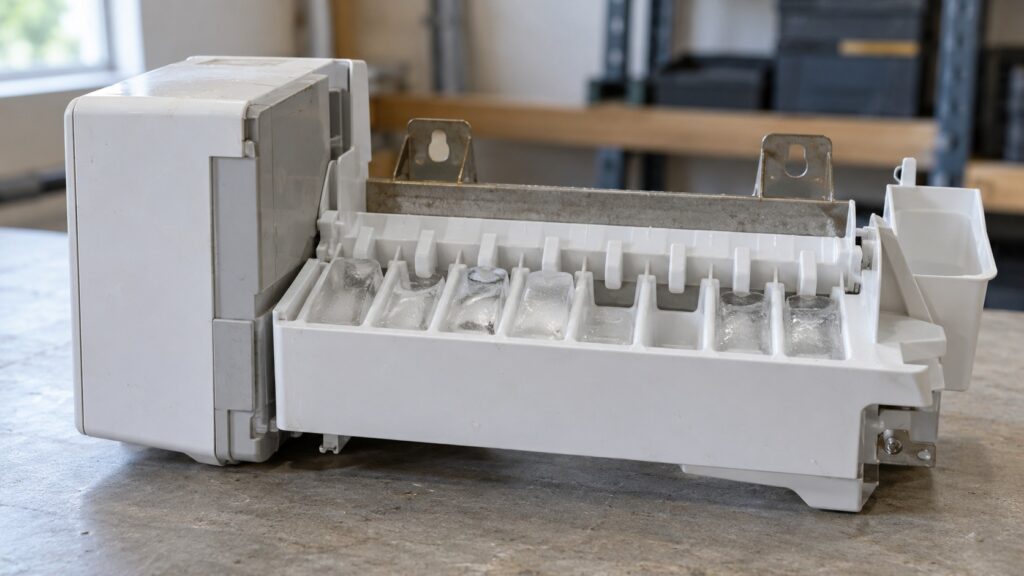
The Kenmore ice maker heater is the small heating element at the ice mold that warms the mold briefly at the end of the freeze cycle so the finished cubes loosen and can be pushed out. When it fails, the symptoms are ice that freezes into one block, cubes that will not release, an ejector that stalls or a bin that stays empty although water is filling. This guide explains what the heater does, where it sits in the sequence of parts our site lists for Kenmore ice makers, which symptoms point to it and which do not, who tests it and why you should not try the test yourself. Our own parts pages do not name the heater specifically, so we separate what they say from the general way a mold heater works.
What does the Kenmore ice maker heater do?
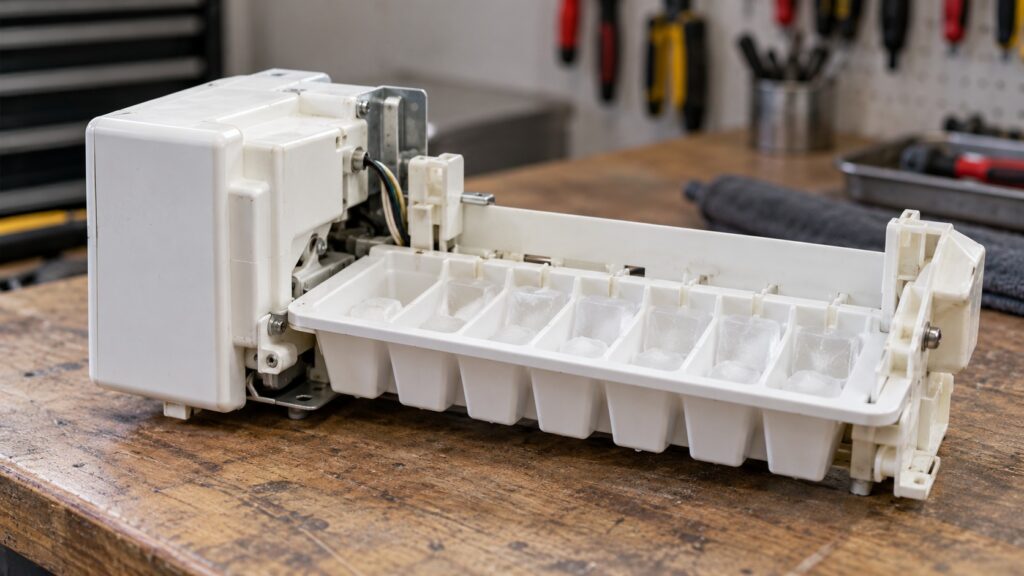
Ice forms in the mold as a single connected tray of cubes. To release it, the ice maker warms the mold for a short moment so that the surface layer of the ice melts and the cubes let go. Then the ejector arm rotates and pushes them into the bin. The warming is the job of the mold heater. Our Kenmore ice maker parts guide describes the other parts of the cycle: the fill valve that controls how much water enters the mold, the thermostat that senses when the ice has frozen solid enough to trigger the ejector, and the ejector arm and its motor. The heater works between the thermostat and the ejector, which is why a heater problem can look like an ejector or a thermostat problem.
Which Kenmore ice makers does this apply to?
Our guides say that most standalone Kenmore ice makers are built by Whirlpool under a 106-prefix model number and are largely mechanical, built around a water fill cycle, a freeze cycle and an ejector mechanism. Our model pages list the 106.89553100 as a Whirlpool-built freestanding ice cube maker, the 106.89589702 as a freestanding ice maker and the 106.678101 as a Whirlpool-built water and ice system integrated into a refrigerator. LG-built refrigerators with 795 or 796 prefixes use their own codes for the ice maker, such as Er IS for an ice-maker sensor failure and Er It for an internal ice-maker system error, which we list on our code pages. So the first step is to read your model prefix with our model number decoder.
What symptoms point to a failed mold heater?
- The mold fills with water and freezes, but the cubes stay stuck and the ejector strains or stops.
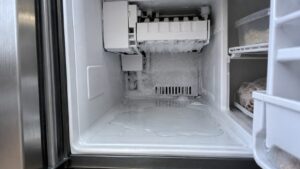
- A solid block of ice sits in the mold or the bin area instead of separate cubes.
- The cycle repeats without any ice reaching the bin.
None of these is proof. A jammed ejector arm, a thermostat that never triggers the ejector or a fill valve that overfills the mold can all produce the same picture. Our guide to a Kenmore ice maker not making ice lists the physical causes in order: a frozen or kinked water line, a clogged fill valve and a stuck ejector arm, and these are easier to check than the heater.
What should you rule out before suspecting the heater?
- Check that the water supply valve is open and the line is not kinked or frozen.
- Look at the water filter. Our maintenance guide says a clogged filter starves the ice maker before it affects taste, giving small, hollow cubes first. Replace it if it is overdue.
- Check that the freezer is genuinely cold. Our guide says a freezer that is too warm collapses ice production.
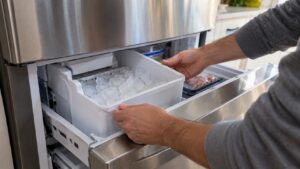
- Look at the bin area for a large chunk of ice that could be jamming the ejector arm. Do not force the arm; leave a stuck arm to a technician.
- Remove old ice from the bin and let the maker run through a full cycle.
How is the ice maker heater tested?
Testing the heater is electrical work for a technician, who works with the power off and follows the specification for your model. Our site does not publish any test readings, because they differ by model. This is not a test for an owner: do not probe the connector or the heater, and do not pry the mold apart.
If the heater is faulty, the replacement is usually an ice maker assembly or heater part matched to the model. Our parts lookup guide explains how to match a part by model number rather than by badge.
When should you call a technician?
Call when you have ruled out the water supply, the filter and the ejector and the ice maker still does not release its ice, or when the unit shows an ice maker code. Our Kenmore ice maker repair technicians test the fill valve, the thermostat, the heater and the ejector motor and replace only what has failed. We are an independent repair company, not a factory service arm. For regular care, read Kenmore ice maker maintenance. You can book a visit and tell us the model number and what the ice looks like.