
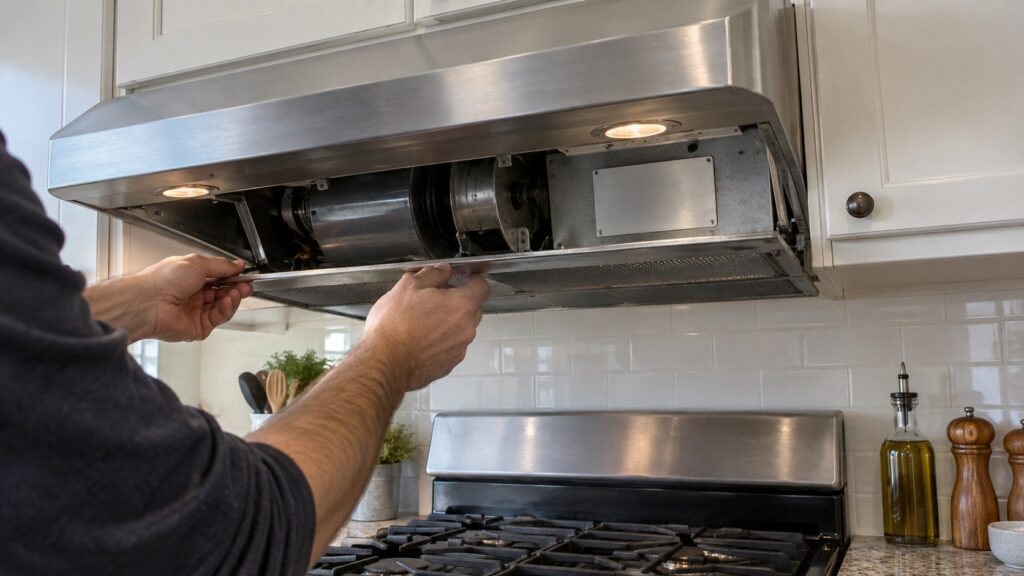
If your hood’s rating plate starts with 233, you own one of a long-running family of Kenmore ducted and ductless range hoods, and the digits after the prefix are what a parts counter actually needs. A kenmore range hood model 233 number such as 233.51840590 or 233.55023007 identifies the build, the width, the blower fitted and the lens shape — four things that decide whether a filter, a wheel or a lamp will drop in or sit in the box waiting to be returned. This guide explains how to read the number and which parts of a 233 hood are worth replacing.
What does the 233 prefix on a Kenmore range hood tell you?
Kenmore appliances carry a three-digit prefix that names the manufacturer who built them, and 233 belongs to the range hood line. Knowing that saves the first wasted hour: a hood searched by the words on the front panel returns dozens of look-alikes, while the same hood searched by its full number returns one exploded parts diagram.
Within the series the numbers run in families. Hoods numbered in the 5184 and 5234 range sit alongside 5324 and 5205 builds, and later 5501 and 5502 numbers cover more recent runs. They share a layout — a shallow canopy, a pair of mesh filters, a centrifugal blower and a switch bank on the front edge — while differing in width, blower rating and lamp fitting.
What the number cannot tell you is whether yours is currently ducted or ductless. Installers convert these both ways, and the presence of a charcoal filter behind the mesh is the real evidence. Our range hood installation guide covers the duct and recirculation options.
Which filter fits a 233 hood?
Two filters, two jobs. The aluminum mesh grease filters are the ones you see, and they slide out on a spring catch at the front lip. They trap grease and are meant to be washed, not replaced, until the mesh tears or crushes.
The charcoal filter behind them exists only on ductless installations, where the air goes back into the room. It cannot be washed. Its job is odor, not grease, and it is spent within six months of normal cooking whether it looks used or not.
Order by measuring rather than by model alone. With the mesh out, measure the opening across and front to back, note whether the catch is on the long side or the short side, and match those to the part listing. Two 233 hoods of the same width can take different mesh sizes if their production runs differ. Our Kenmore parts lookup guide explains how to match a number to a diagram before you buy.
What about the blower wheel and the motor?
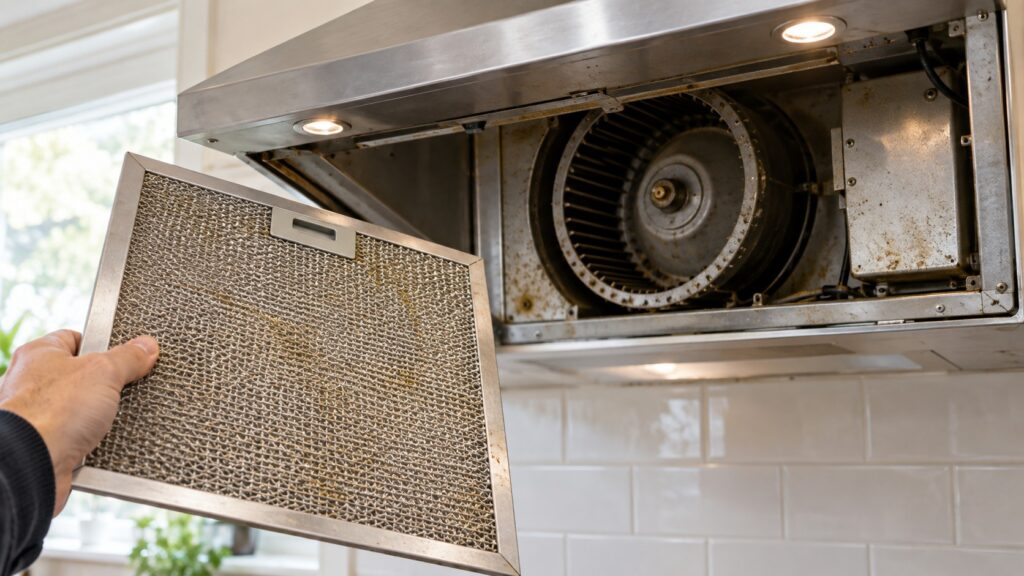
The blower is a squirrel-cage wheel on a shaded-pole motor, mounted in a housing at the top of the canopy. Grease that gets past a torn or bypassed mesh filter builds up on the wheel’s vanes, and because it never builds up evenly, the wheel ends up out of balance. That is the source of most of the noise complaints on these hoods.
A wheel that is merely dirty can be cleaned: the hood comes down or the housing cover comes off, the wheel pulls from the shaft, and a hot degreasing soak does the rest. A wheel with a cracked hub, or a motor whose bearings have gone dry and squeal on startup, is a replacement. Motors for this series are usually sold as an assembly with the wheel, which is the sensible way to buy them.
If the fan runs but moves no air, suspect the damper rather than the blower — more on that below. If it does not run at all, our fan not working guide follows the electrical path.
Which lamp and lens does a 233 take?
Older 233 hoods use an appliance-rated incandescent bulb behind a glass or plastic lens, held by two screws or a twist collar. Later runs moved to a small fluorescent tube, and the most recent to an LED module that is part of the fixture rather than a user-replaceable lamp.
Two cautions. First, an ordinary household bulb in a hood socket runs hotter than the fixture was designed for and yellows the lens; appliance bulbs exist for this reason. Second, lens clips go brittle with heat, so order the clip along with the lens when one has already cracked. Routine cleaning of the lens and switch bank is part of our range hood maintenance guide.
What else fails on this series?
The rocker or slide switch bank is the next most common part. These switches carry the blower current directly, and years of grease vapor work into the contacts until one speed stops selecting. They are a plug-in replacement on most runs.
After that come the backdraft damper, a pair of light flaps in the duct outlet that stick shut when they are greased up and turn a working blower into a hood that moves nothing; the duct transition collar, which loosens and leaks back into the cabinet; and the mounting screws, which on a hood that has been taken down and rehung once too often no longer hold the canopy square.
When should you call instead of ordering parts?
Call when the motor hums but does not turn, when a switch position sparks or smells hot, when the hood runs but the kitchen still fills with smoke despite a clean filter and an open damper, or when the number on the tag no longer matches anything in the listings because the hood was converted years ago. An electrical fault in a grease-laden canopy is not the place to learn by experiment, and the circuit is live even with the switch off.
We are an independent repair company and not a factory service arm. Pricing starts from a diagnostic visit, filters start from $15 and blower assemblies from $90, and we confirm the estimate before any work begins. Kenmore range hood repair covers blowers, switches, lighting and ducting, you can call 1-844-351-4064, or schedule a visit online.