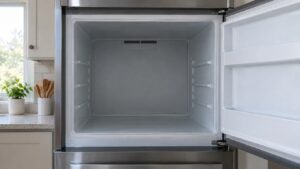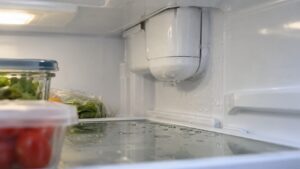
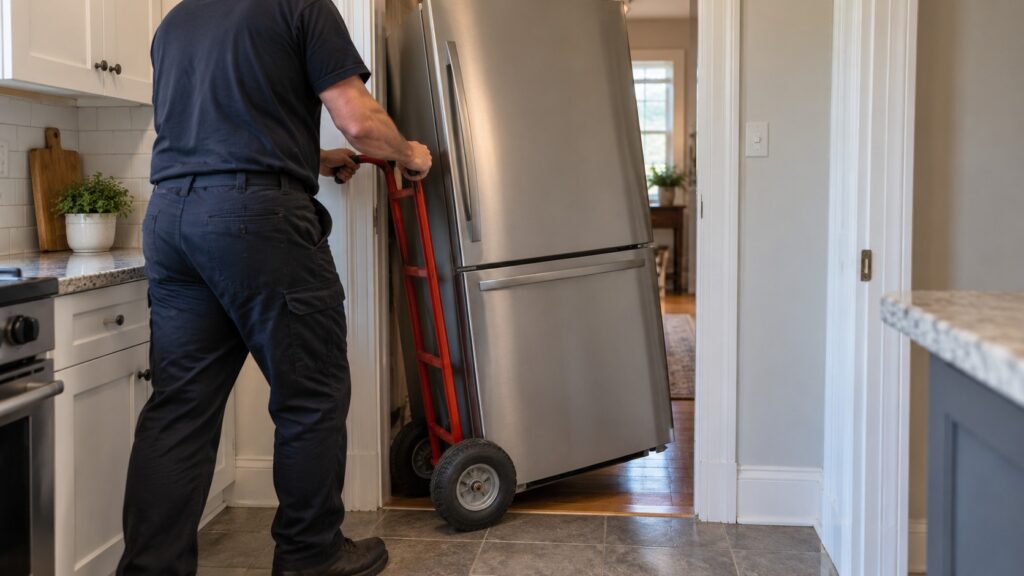
TL;DR: Kenmore refrigerator door removal is a standard way to get a large unit through a tight doorway or hallway. The sequence is the same for most models: measure the path, empty the refrigerator, unplug it, close the water supply and disconnect the line, remove the hinge cover, unplug the door’s wiring connector and water tube if there is one, then lift the door straight up and off. Always check your owner’s manual, because hinge designs differ between builders.
When does a Kenmore refrigerator need its doors removed?
Most refrigerators are designed to fit through a standard 32-inch door when delivered upright, but the real path is rarely a clean straight line. Older houses have narrow entry doors, hallways turn corners, and a door frame that looks wide enough often loses an inch to a hinge or a casing. A French-door or side-by-side model is wide and tall. If your Kenmore does not clear the narrowest point by about an inch on each side, removing the doors reduces its width enough to pass, and it saves scraped walls and a scratched finish.
Taking doors off is also useful for replacing a refrigerator in a built-in opening, where depth and swing space are tight. Our Kenmore refrigerator installation guide covers the final placement once the unit is in the room.
How do you measure the path first?
Measure the refrigerator at its widest, deepest and tallest points, including handles. Then measure the narrowest point of every doorway on the route, from the truck to the final spot: front door, hallway, turns, kitchen opening. Measure the clear opening with the door open, not the frame, because the door itself can intrude on the space. Write the numbers down and compare. For turns, remember that a long item must pivot, so you need more clear space at a corner than the width alone suggests. Taking the doors off gains you the thickness of the doors plus the handles, which is often just enough.
How do you prepare the refrigerator?
- Empty everything from the doors and the shelves, including bins. Door contents are heavy and shift.
- Unplug the refrigerator. Never work on hinge wiring with the power connected.
- Shut off the water at the household valve if the refrigerator has an ice maker or dispenser, and disconnect the supply line from the back.
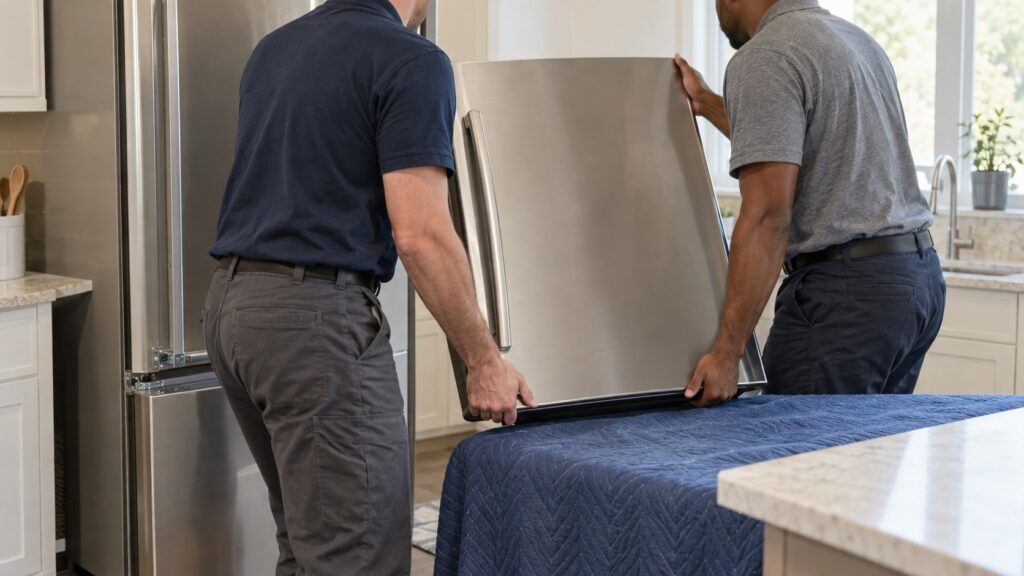
- Clear the floor and lay down a moving blanket or cardboard for the doors.
- Get a helper. Refrigerator doors are heavy and awkward, and a falling door can hurt you or break.
If the refrigerator holds a water filter or has a dispenser tube in the door, expect a little water when you separate the line. Keep a towel ready.
How do you take the doors off?
The details depend on the hinge design, which is why your manual matters. The general sequence is this:
- Open the door and remove the hinge cover or the top cover so you can reach the hinge and the wiring.
- Disconnect the wiring connector for the door, usually by pressing a tab and pulling the plug apart. Do not yank on the wires.
- If the door has a water line, release the tube using the fitting’s release collar, and note how it connects.
- Remove the screws or the retaining bracket holding the hinge. Hold the door while you do, because it can swing or fall when the last screw is out.
- Lift the door straight up and off its hinge pin. With a second person, carry it to the padded surface and stand it upright or lay it flat as the manual advises.
- Repeat for the other doors, labeling any screws and parts you remove, and photograph the connections before you separate them.
On bottom-freezer or French-door models with drawers, follow the manual for the lower door or drawer front. Some models need the drawer removed before the door.
How do you put the doors back and check the result?
Reverse the steps. Lift each door onto its hinge pin, secure the hinge, reconnect the wiring and the water tube until they click or seat fully, replace the covers, then check that each door hangs level and the gap between doors is even. Reconnect the water line, open the valve slowly and look for drips. Plug the refrigerator in and leave it for several hours before putting food in, so the temperature settles. Open and close each door, listen for the seal, and check the door alarm or any display message. If a door does not seal evenly, adjust the hinge or the leveling feet per the manual. A refrigerator that was moved should also stand upright for a while before it is switched on, as the manual advises.
If a door will not align, a connector will not seat or something leaks after the job, our Kenmore refrigerator repair technicians can sort it out, and the refrigerator leaking water guide covers drips. You can book a visit with your model number. For models that are the 795 series, see 795 refrigerator installation.