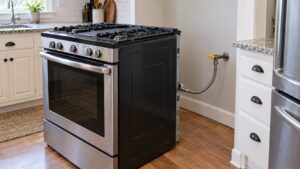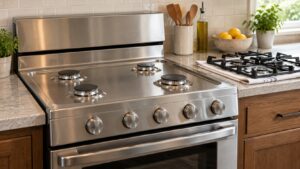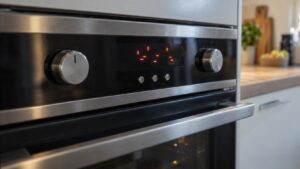
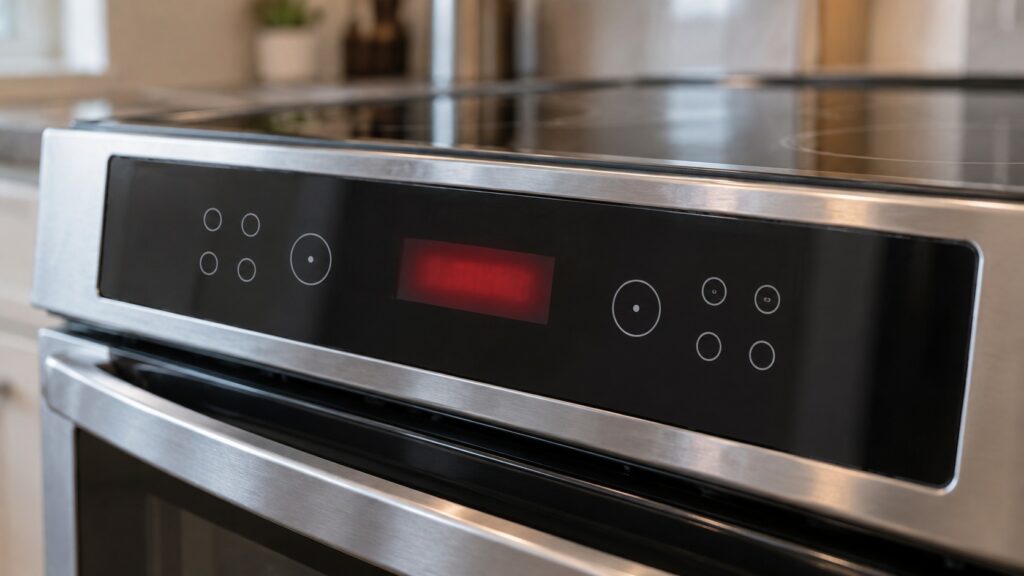
On a Kenmore range, F11 means a shorted keypad: the control is reading a key as pressed when nobody is pressing it, and it stops cooking rather than act on a command it cannot trust. That answer holds for the Frigidaire and Electrolux-built Kenmore ranges and wall ovens, which carry model prefixes 119, 253, 336, 417, 587, 622, 628, 719, 790, 791 and 970. It does not hold for every appliance with a Kenmore badge, and that is the part almost every generic code chart gets wrong.
What does F11 mean on a Kenmore range?
The touch panel is a membrane with printed traces. Pressing a key bridges two traces, and the control reads the bridge as a command. When moisture, grease or a cracked trace bridges those contacts permanently, the control sees a key held down forever. F11 is the control saying so and refusing to continue.
In practice that looks like a range that beeps on its own, cancels a bake partway through, or will not accept any input at all while the display holds the code. Sometimes one key responds and the rest do nothing, because the stuck key is taking priority over everything else.
The practical consequence matters more than the wording: a Kenmore F11 is not a heating fault, not a sensor fault and not a gas fault. Replacing a bake element or an oven sensor because the display showed a code will not change anything here.
Why does the same code mean something else on another Kenmore?
Kenmore has never been a factory. It is a label applied to appliances built by several manufacturers, and each manufacturer brought its own control software and its own code table. Two ranges bought in the same year, both badged Kenmore, can show the same characters for entirely different reasons.
This site keeps the codes separated by build for exactly that reason. On the Whirlpool-built platform, F1 reports a failed Electronic Range Control board. On the GE-built platform, the F0, F1, F6 and F7 group reports a keypanel problem. On the Frigidaire and Electrolux platform, F11 is the shorted keypad and F10 is a runaway temperature. Reading the wrong column sends you after the wrong part with complete confidence.
Our guide on who makes Kenmore appliances sets out which manufacturer sits behind which range of models, and it is worth five minutes before ordering anything.
How do you find out who built your range?
The first three digits of the model number carry the answer. The tag is on the frame behind the storage drawer, along the oven door frame, or on the side of the control housing on a slide-in unit. Write down the whole number, including the digits after the period — they identify the production run, and parts differ between runs.
A 790 prefix, the most common on Frigidaire and Electrolux-built Kenmore ranges, is where F11 belongs. A 665 prefix on a range or wall oven points at the Whirlpool family. A 911 prefix points at GE. Our Kenmore model number decoder walks through reading the rest of the tag, and the same number is what a parts counter will ask for first.
Can you clear F11 yourself?
- Cut power at the breaker for five full minutes. Pulling a range’s plug is often impractical, and the breaker does the same job.
- Restore power and let the clock come up without touching a key.
- Press each key once, slowly, and note any that feel mushy, stay lit, or produce no beep at all.
- Wipe the panel with a barely damp cloth and dry it completely. Cleaner sprayed directly at the panel wicks under the membrane and causes this code by itself.
- Watch for an hour of ordinary use. A code that stays away after a power cycle was a transient; a code that returns is a failed panel.
Is it the keypad or the control board?
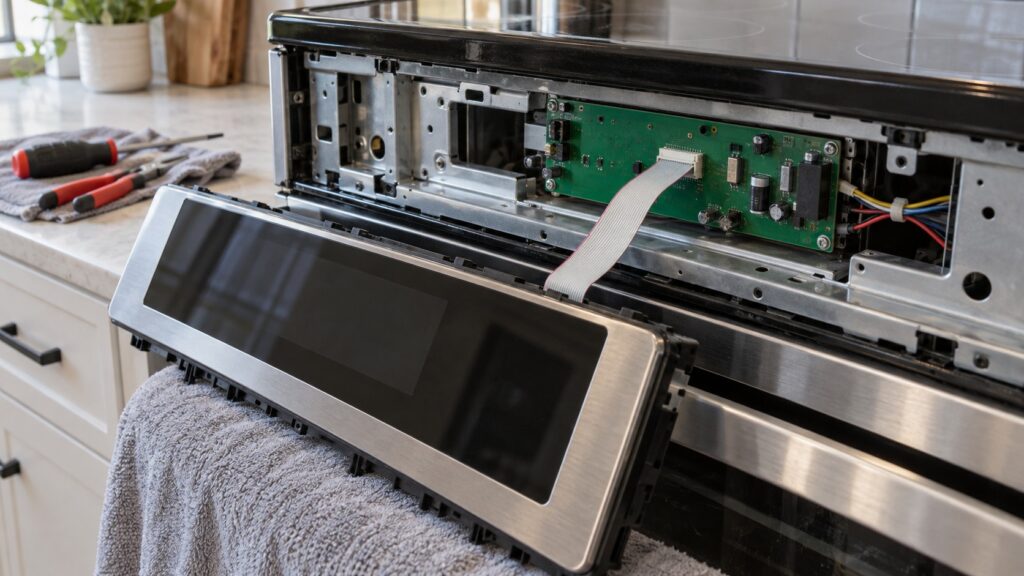
On most of these builds, the touch panel and the control board are separate parts joined by a ribbon cable, and the ribbon is the thing to check before condemning either. A ribbon that has backed partly out of its connector, or that has been pinched during a previous repair, creates the same permanent bridge a failed key does.
The rule of thumb technicians use: if disconnecting the keypad ribbon makes the code go away, the fault is in the panel. If the code stays with the panel disconnected, the board is reading a short on its own side and the board is the part. That test takes a minute for someone who does it weekly, and it takes place inches from the range terminal block, which is why it belongs to a technician rather than an evening project.
Age helps you guess which way it will go. Panels fail from the outside in, so a range that has lived under a steamy pot rack or been wiped with spray cleaner tends to lose its panel first. Boards fail from heat and from voltage events, so a range that took a lightning strike or sits above a hot self-cleaning cavity is the one where the board goes first. Neither guess replaces the ribbon test, but it tells you which part to have quoted.
Codes in the F3 group behave differently again — those are sensor circuit faults, and our F3E0 and F3E1 guide covers them.
When should you call for service?
Call when the code returns after a clean power cycle, when the range cancels a cycle on its own, when a key is visibly delaminated or bubbled, or when the panel has been sprayed with cleaner and stopped responding since. Do not keep resetting the breaker to force one more bake out of it: a control that misreads inputs can also misread a temperature command.
We are an independent repair company and not a factory service arm. Pricing starts from a diagnostic visit, touch panels for these builds usually start from $120 in parts, and we confirm the estimate before any work begins. Kenmore range repair covers panels, boards and elements, you can call 1-844-351-4064, or schedule a visit online. Related reading: our F10 error code guide for the runaway temperature code owners most often confuse with this one.