Kenmore dishwasher error codes depend on who built the dishwasher. Kenmore does not make its own dishwashers, and the first three digits of the model number tell you the builder. Our code pages cover the Whirlpool-built dishwashers (model prefixes 106, 110, 198, 664, 665 and 850), where the codes are in the F-and-E family: F2 is a water leak detected, F2E2 a main control communication error and F9E1 a long-drain condition. Frigidaire-built (587, 719, 790) and GE-built (362, 363) dishwashers use different code families, and our site does not publish their meanings.
How do you know which builder made your Kenmore dishwasher?
Open the dishwasher door and look along the top edge of the tub opening, where the model and serial tag is printed on nearly every Kenmore dishwasher. Read the first three digits before the first period. Our builder guide says a 665 means Whirlpool built the machine and a 587 means Frigidaire did. The two control boards use different code schemes entirely, so a code that means one thing on a 665-prefix unit can mean something else, or nothing at all, on a 587-prefix unit. Confirm the prefix before you search for a code. Our guide on whether your dishwasher is Whirlpool or Frigidaire built covers the check in more detail.
What are the Kenmore dishwasher error codes on Whirlpool-built models?
These are the codes our site documents for the 106, 110, 198, 664, 665 and 850 prefixes. For each, the meaning below is the one stated in the body of its code page.
- F2: a water leak was detected. Our page calls it a protective response that stops the unit before water spreads further.
- F2E2: a main control communication error.
- F6E1: a user-interface error, main control.
- F6E2: the water inlet valve windings are open, an electrical problem in the valve itself, not in the water supply.
- F6E3: a SUDS alarm caused by excessive suds in the drain system. Our page says that using dish soap or another non-dishwasher detergent, or too much detergent, is the leading cause.
- F6E4: the control detected the float switch open, often an overfill condition. Our page says that incorrect leveling can actuate the float switch and trigger the code.
- F9E1: a long-drain issue, meaning the dishwasher is not draining properly.
Our pages state that F2E2, F6E1 and F9E1 are verified Whirlpool codes, confirmed on Whirlpool’s own product-help site. F2 and the F6E2, F6E3 and F6E4 codes are described as verified through Whirlpool-platform references.
Which codes does our site list as typical patterns?
Five codes are presented on our pages as typical or pattern codes, which our pages say were not confirmed on a Whirlpool primary page. They are F1E1, a stuck relay on the electronic control board; F1E2, corrupted or incompatible memory on the control board; F3E1, a thermistor (water-temperature sensor) or optical water indicator problem; F8E1, a slow-drain condition; and F8E2, a drain pump electrical problem. Treat these as likely meanings, not certain ones, and read your owner’s manual if it lists the code. Note too that the Whirlpool-built washer has its own F8E1, a water-fill problem, so match the code to the appliance.
What do Frigidaire-built and GE-built dishwashers show?
Our F2 page says that if your dishwasher’s model number starts with 587, 719 or 790 (Frigidaire or Electrolux-built) or 362 or 363 (GE-built), the F2 code does not apply, and that those platforms use their own “i” or “F”-family codes. Our 587 not-draining guide says Frigidaire and Electrolux dishwashers display an i-prefixed code system, for example iE, i30 or i70, and that we are intentionally not publishing what each i-code means because we cannot verify those meanings to the standard we hold. So for a 587-prefix dishwasher, use the physical checks in our 587-series not draining guide, and read your owner’s manual for the code.
What can you check yourself?
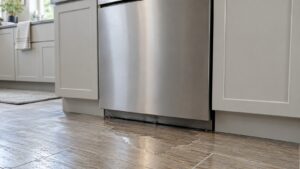
The checks on our code pages are short. For F2, confirm you are using proper dishwasher detergent in the correct amount, not dish soap or too much detergent, and look for water pooling under or around the unit. Our page says to leave the dishwasher powered off and the water supply off overnight before retesting, and that if F2 returns, you should treat it as a genuine leak and stop running cycles. For F2E2, our page gives Whirlpool’s own first step: disconnect the appliance from electricity for 30 seconds, by unplugging it or switching off the breaker for a hardwired unit. For F1E1, our page says to power the dishwasher off at the breaker for a few minutes and restart, and not to keep cycling the power, and for F6E1 to cycle power and call for service if the code remains. For slow drain, check the drain hose for kinks, clean the drain pump filter and check the air gap and the garbage disposal knockout plug.
Do not open the control panel or the base of the dishwasher. If there is water near the outlet, switch off the breaker at the panel while you stand on a dry floor, and do not pull the plug from a wet outlet.
When should you call a technician?
Call if F2 returns after you have ruled out over-foaming, because our page says that needs a technician to trace the leak and test the float switch and tub seals. Call too for the control board codes (F1E1, F1E2), the communication errors and for any drain code that persists after the hose, the filter and the air gap are clear. Give the technician the full model number with the prefix, the exact code and what you tried. Our guide to the Kenmore model number decoder and who makes Kenmore appliances explain why the prefix matters. See the F2 code page and the F8E1 guide for detail.
We are an independent repair company, not the manufacturer. Our Kenmore dishwasher repair team works on both platforms, and you can schedule a visit online.