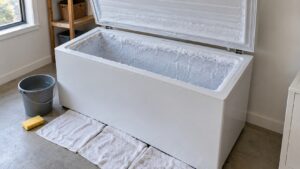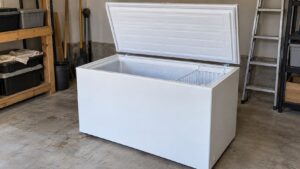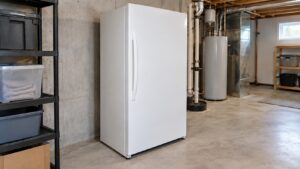
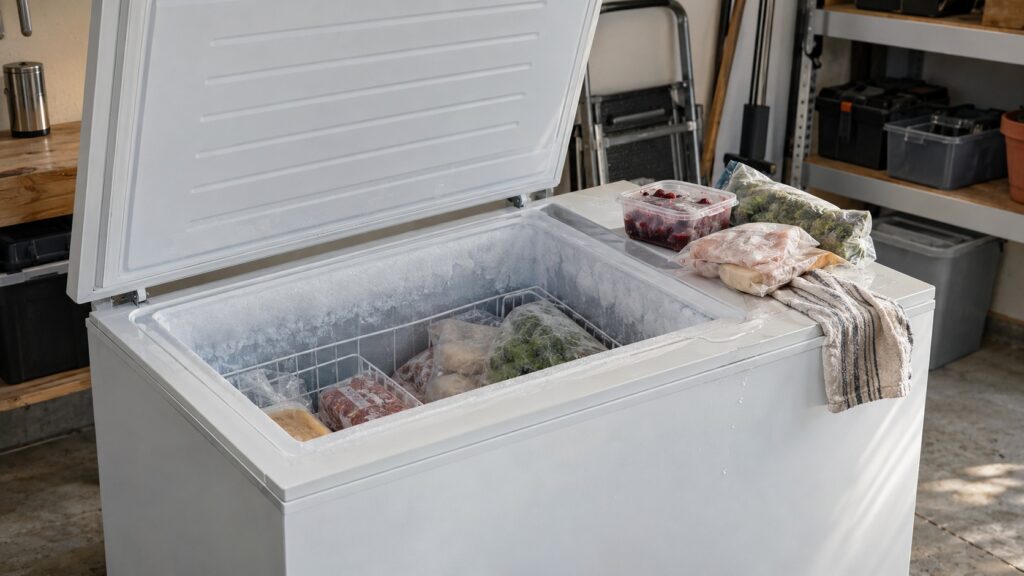
A Kenmore deep freezer thermostat problem and a start relay problem both show up as a freezer that is not getting cold enough. Our freezer guide lists them together with the usual causes: a worn lid seal, dusty condenser coils, a thermostat that has drifted out of calibration or failed, a start relay or capacitor that stops the compressor from running properly, or a freezer overloaded past its rated capacity. Our pages call a deep freezer a chest freezer. Most Kenmore freezers carry a 253 prefix, which means Frigidaire built them, and most are mechanical rather than digital, so there is no error code to read. Diagnosis starts with what the freezer is doing.
What does a thermostat do in a Kenmore chest freezer?
The thermostat decides when the compressor runs. Our freezer guide says Frigidaire’s standalone freezer platforms are largely mechanical rather than digitally controlled, so the control is a thermostat with a dial, not a display. Our 253 freezer guide adds that most chest models in the 253 series are manual defrost, with no heater, no timer and no defrost drain to block. A thermostat that has drifted out of calibration or failed can leave the freezer running at the wrong temperature, and the guide lists it as a common cause when the unit does not freeze properly. Our pages do not describe the thermostat’s internals or its settings, so for the dial positions on your model, read the owner’s manual.
What does the start relay do?
Our freezer guide says a start relay or capacitor that prevents the compressor from running properly is one of the common culprits when a freezer does not freeze. If you listen and the compressor is silent, the guide says the start relay or the compressor may be responsible. Our pages do not describe how a relay works or how to test one, and testing it means working on live mains wiring. Treat the start relay as a technician’s job: do not open the compressor’s cover and do not try to swap one.
What should you check first?
Our guide lists first checks that are safe for an owner:
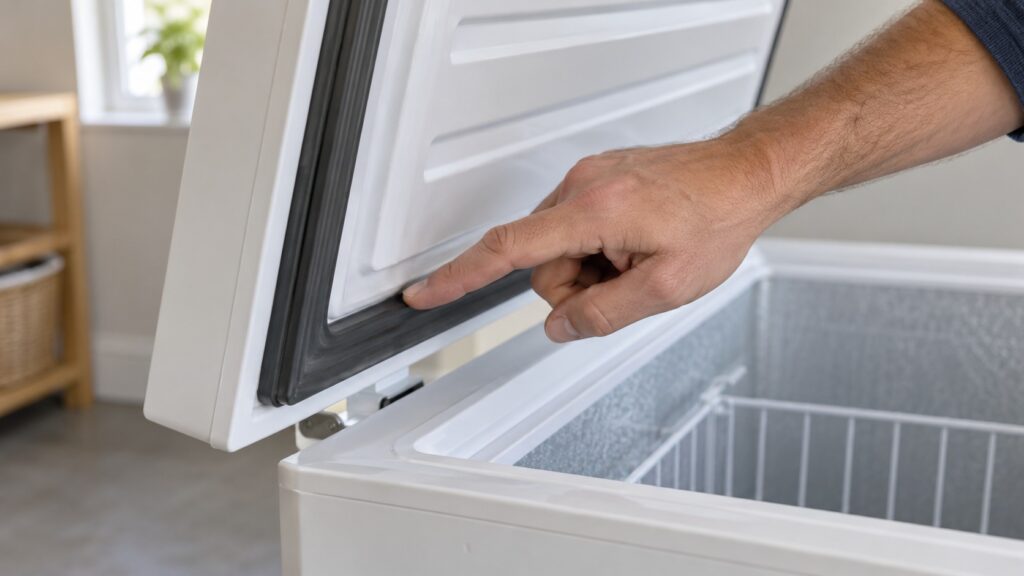
- Check the lid gasket for gaps, tears or a weak magnetic seal. Our freezer guide says a worn seal lets in warm air.
- Vacuum the condenser coils, typically on the back or bottom of the unit. Do this with the freezer unplugged, and do not bend the fins.
- Confirm the thermostat dial has not been bumped to a warmer setting.
- Listen for the compressor. If it is silent, the start relay or compressor may be responsible.
- Check the load. Our guide says a chest freezer overloaded past its rated capacity forces the compressor to run constantly without ever reaching the set temperature.
- Check the outlet. Plug the freezer directly into a wall outlet, not a power strip or extension cord, since our guide says some strips do not reliably supply the steady current a compressor needs on startup, which can mimic a compressor failure.
How do you read the pattern?
Our guide suggests noting how the freezer is behaving before you call. If the compressor runs constantly without ever reaching temperature, that usually points toward a refrigerant or compressor issue. If it cycles on and off unusually often, that often points toward a thermostat or a start relay. If it is silent, either a power supply issue or a compressor that has failed outright is likely. Write down which of the three you see, how long it has been going on and whether the lid seal and the coils were already clean. A technician who knows the pattern can arrive with the likely part.
Sealed-system work should never be attempted as a do-it-yourself repair, according to our guide. If the seal is intact and the coils are clean but the freezer still does not reach temperature, the problem is likely internal: a failing compressor, a bad thermostat or a refrigerant leak.
What should you do with the food?
Keep the lid closed as much as possible. Our 253 guide says a chest freezer holds cold well during an outage, often a day or more with the lid kept shut. Per FDA guidance, a full freezer will hold its temperature for about 48 hours if the lid stays closed, and a half-full freezer for about 24 hours. If the freezer cannot be fixed in that time, move the food to another freezer or pack it in coolers with ice. If food has thawed, check its condition and follow FDA guidance before you eat or refreeze it.
When should you call a technician?
Call when the seal is good, the coils are clean and the load is normal but the freezer still does not freeze, when the compressor is silent or when it short cycles. Give the technician the full model number, including the digits after the period, and the pattern you noted. If water is around the freezer, or if the cord or the outlet is damp, switch off the breaker at the panel while standing on a dry floor, and do not pull the plug from a wet outlet. Our Kenmore freezer not freezing guide covers the symptom, the frost buildup guide covers a freezer that is icing up and the freezer repair cost guide helps you decide whether to fix an older unit. See also the 253 freezer models guide and freezer maintenance.
We are an independent repair company, not the manufacturer. Our Kenmore freezer repair team can diagnose a thermostat or relay fault, and you can schedule a visit online.