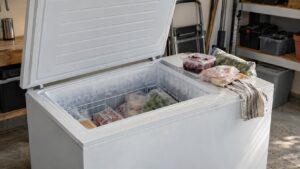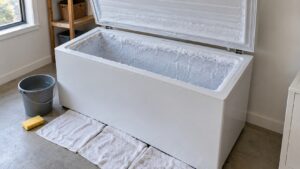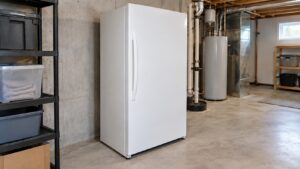
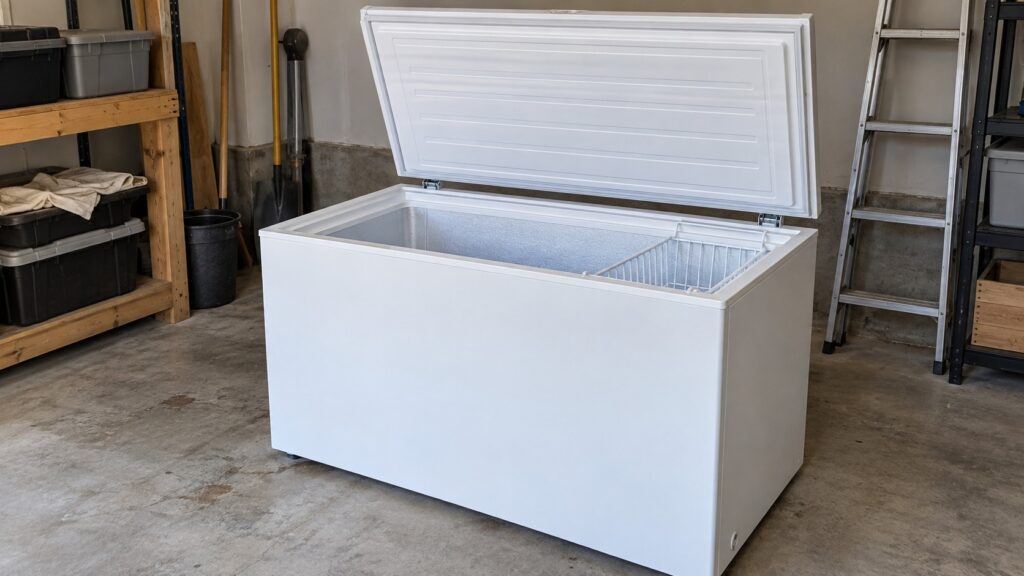
The number on the tag settles most of the questions people ask about these units. A kenmore 253 freezer is one of the Frigidaire and Electrolux-built models sold under the Kenmore name, and the digits after the prefix say whether you are looking at a chest or an upright, roughly when it was built, and which gasket, lid switch and thermostat will fit it. Numbers such as 253.28432803, 253.28052801, 253.28262801 and 253.9163210 all belong to this family, and they are common enough on the used market that knowing how to read one is worth more than any feature list.
What does the 253 prefix actually tell you?
Kenmore never built appliances itself. The three-digit prefix on the tag names the manufacturer that did, and 253 is one of the Frigidaire and Electrolux prefixes — the same family that covers a number of Kenmore ranges and refrigerators. That matters because a Kenmore freezer built by a different manufacturer takes different parts even when the outside looks similar.
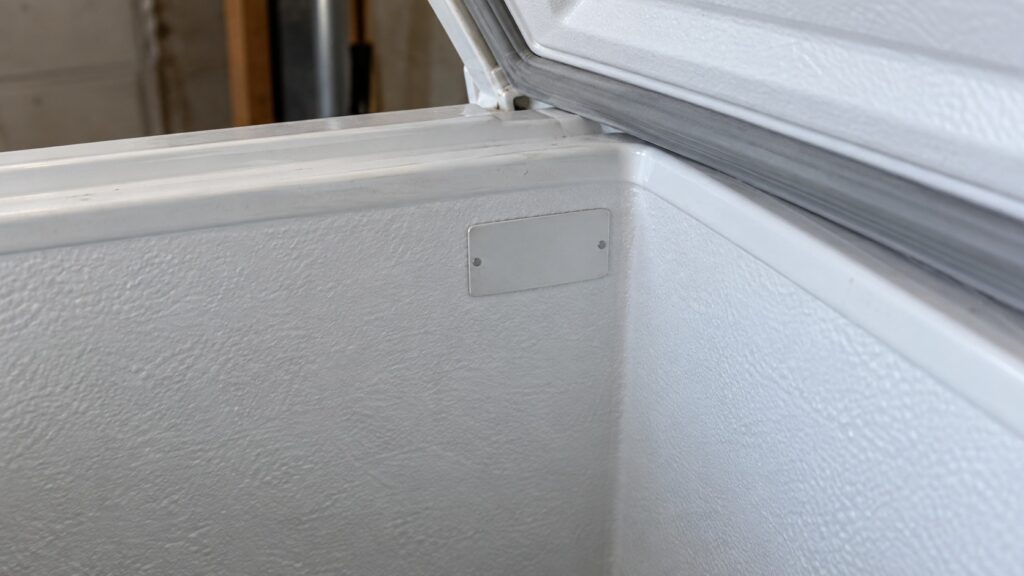
The tag is on the rear wall of a chest model, near the compressor housing, and inside the door frame or on the back of an upright. It carries the model, the serial and the refrigerant charge. Photograph it before you buy anything, because a freezer full of food is not something you want to empty just to read a label. Our Kenmore model number decoder explains the rest of the tag.
Chest or upright: which layout suits you?
A chest model keeps cold air in when the lid opens, because cold air sinks. That gives it two advantages: a lower running cost for the same capacity, and far longer safe holding time during a power outage — often a day or more with the lid kept shut. The trade is access. Anything at the bottom of a chest is effectively in storage.
An upright trades some of that efficiency for shelves and door bins, which is what most households actually want day to day. It also takes about half the floor area for the same capacity, which decides the question in a small garage.
Placement rules are the same either way: room to breathe at the back and sides, a dedicated outlet, and a floor that is level enough for the lid or door to seal. Our freezer installation guide covers clearances and the first run.
Manual defrost or frost-free?
Most chest models in the 253 series are manual defrost. There is no heater, no timer and no defrost drain to block, which is exactly why they last: the parts that fail on a frost-free unit simply are not there. The cost is an afternoon once or twice a year with the food in coolers while the frost melts.
Frost-free uprights melt their frost on a schedule instead. That is convenient, and it also adds a defrost heater, a bimetal or thermostat and a drain path to the list of things that can fail. A unit that is building frost where it never used to is telling you one of those three has quit, which our frost buildup guide walks through.
Neither type is better. Choose manual defrost for long-term bulk storage and reliability, frost-free for a unit you open daily and do not want to service.
What size do you actually need?
The working figure is one and a half to two cubic feet of freezer space per person for ordinary household use, and considerably more if you buy meat in bulk or preserve a garden. The 253 series spans roughly 5 cubic feet for a small chest to about 21 for a large upright, so there is a size for most cases.
Resist buying larger than you will fill. A half-empty freezer costs the same to run as a full one and holds temperature worse during an outage, because there is less frozen mass to carry it. If the unit is going in a garage, check that it is rated for the temperature range your garage actually reaches in winter, since some models stop calling for cooling when the ambient air is cold enough to fool the thermostat.
What should you check on a used 253 freezer?
Take ten minutes with it running. Run a hand around the gasket for stiffness and gaps; close the lid on a dollar bill and see whether it pulls out easily, which tells you the seal has gone flat. Look at the frost pattern inside: even light frost is normal, while a heavy wall of ice on one side suggests a seal or door alignment problem.
Listen to the compressor for a full cycle, checking for the rattles and clicks that suggest mounts or a relay. Open the lid and look at the interior liner for cracks, especially at the corners where a dropped item lands. Smell the inside — an odor that survives cleaning usually means a unit that once thawed and sat full, and that odor rarely leaves the foam insulation.
Finally, plug it in and leave it an hour with a thermometer inside. A healthy unit will be heading toward zero degrees Fahrenheit without running continuously. If it runs without getting there, our not freezing guide covers what that usually means.
Are parts still available, and who should look at one?
For this series, the wear parts are generally still available: gaskets, lid and door switches, interior lamps, thermostats, defrost components on frost-free models, and baskets. Sealed-system parts are a different matter and are rarely worth pursuing on an older unit. Keeping the coil clean and the gasket supple, as in our freezer maintenance guide, is what decides how long one of these lasts.
We are an independent repair company and not a factory service arm. Pricing starts from a diagnostic visit, gaskets typically start from $50 in parts, and we confirm the estimate before any work begins. Kenmore freezer repair covers thermostats, seals, defrost systems and controls, you can call 1-844-351-4064, or schedule a visit online.