A Kenmore gas line hookup connects the range to the house gas supply through a shutoff valve and a flexible connector rated for range use, and it ends with a leak check that the installer performs before the range is used. This guide explains the parts of the connection, what to prepare, what changes for natural gas and propane, how the anti-tip bracket and the connector fit together, and what to do if you ever smell gas. It is deliberately not a do-it-yourself procedure: connecting or altering a gas line is work for a qualified installer or licensed gas fitter, and local codes may require one, so use this to plan the job and to know what a good installation looks like.
What does a gas range connection consist of?
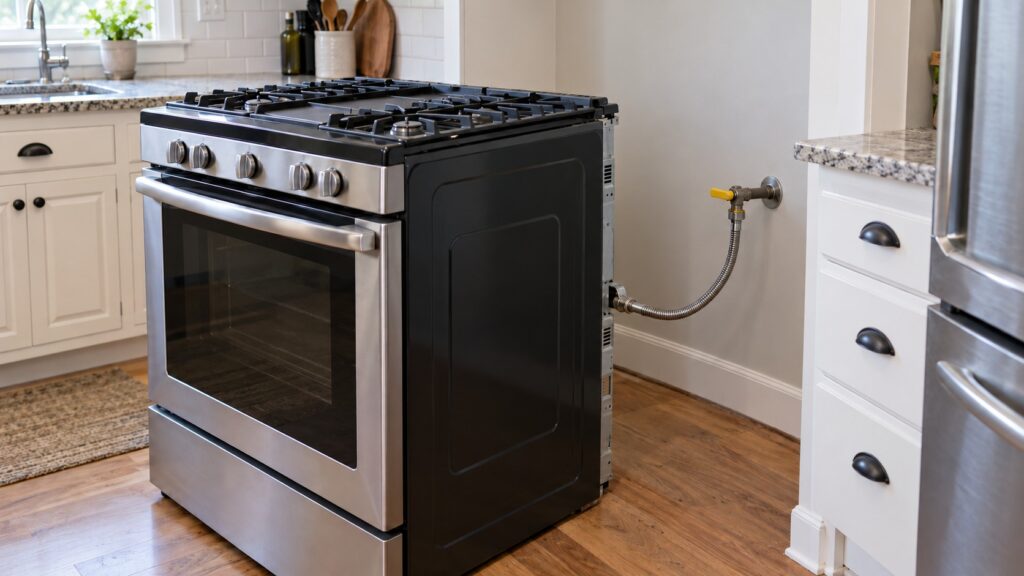
Our Kenmore range installation guide says a gas range needs a dedicated gas line with a shutoff valve and typically a flexible connector rated for range use. The valve is the point where you can stop the gas. The connector is the flexible line between the valve and the range’s inlet. Everything else, such as the pressure regulator and the burner orifices, is part of the range and should be left exactly as the manufacturer supplied it. Because Kenmore ranges are built by different manufacturers, connector types and dimensions can differ between two ranges that look alike, so start from the installation instructions for your model number.
What should you prepare before the hookup?
- Find the model number on the tag and keep the installation instructions for it. Our model number decoder shows how to read the prefix, which tells you who built the range.
- Confirm that the range is a gas model and that your supply matches. Our installation guide says gas and electric ranges are not interchangeable without proper conversion, and that switching usually needs an electrician or plumber.
- Note where the shutoff valve is and whether it is reachable, and ask the installer to confirm it is the right type for a range connection.
- Check that the range will have the clearances in the manual from cabinets and any combustible surface, and that any overhead hood or microwave has clearance.
- Plan for the anti-tip bracket and for a place on the floor or wall where it can be fastened.
A gas range also needs household electricity for the spark igniters and the controls, so check that an outlet is in the place the manual specifies.
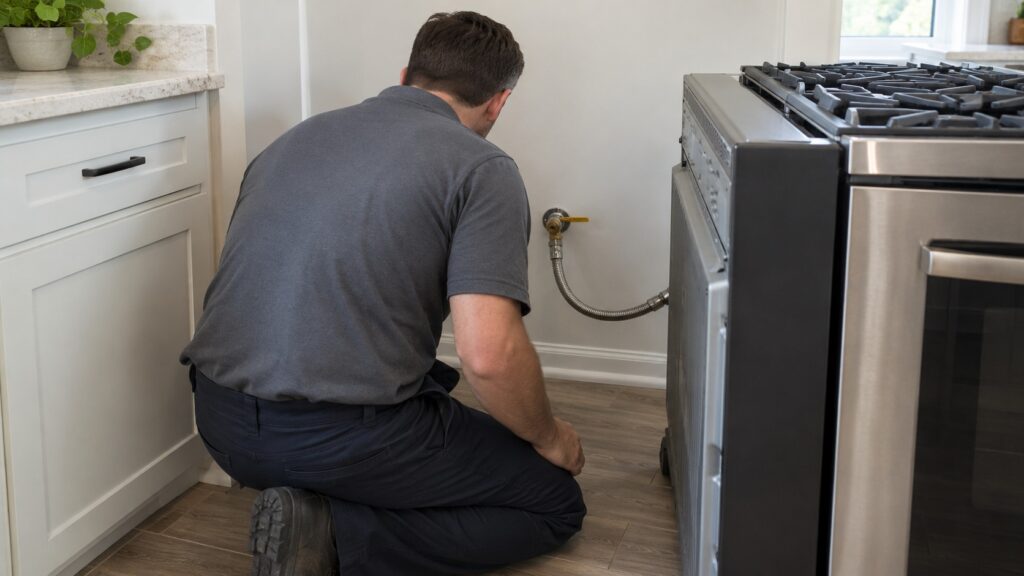
What does a good gas connection look like?
The connector runs from the valve to the range inlet in a gentle curve, not kinked, crushed or stretched. Our installation guide lists a gas connector that is kinked behind the range among the most frequent problems it sees after a do-it-yourself installation, along with a connector or line that is too short, forcing the range to sit pulled away from the wall. After the range is pushed back, the connector should still have slack and should not be pinched between the range and the wall. The range should be level front to back and side to side, using the adjustable feet.
What about natural gas, propane and conversion?
Gas ranges are set up for a particular fuel. Natural gas and propane need different settings, and a conversion is done with parts and instructions from the manufacturer, not by adjusting anything on your own. If the range arrives set for one fuel and your home uses the other, stop and ask a qualified technician to convert it per the manufacturer’s instructions. We do not publish pressure figures or orifice sizes here because they differ by model and builder; use the installation instructions for your exact model.
Why is the anti-tip bracket part of the hookup?
Our guide says every freestanding range ships with an anti-tip bracket that anchors the back to the floor or wall, and that it exists to stop the range tipping forward if someone leans on an open oven door. It is easy to forget to re-hook it when a range is moved for cleaning or repair. Anyone who moves a gas range should leave the connector and the bracket to the installer: moving the range disturbs the gas connection, and the installer confirms the bracket is engaged again before the job is done. A tipping range can also strain the gas connector.
How is the connection tested, and what if you smell gas?
The installer checks every fitting for leaks before the range is used, using a method suitable for gas lines. Do not try to test a gas connection yourself with homemade methods. If you ever smell gas, do not turn anything on or off and do not light anything. Leave the house, and call your gas utility or 911 from outside. Do not go back in until you have been told it is safe. If a burner will not light on a new installation, our burner not igniting guide explains the usual causes, but never keep trying to light a burner when you smell gas.
When should you book a technician?
Book one for any new gas hookup, any move of a gas range that disturbs the connector, a fuel conversion, or a burner that will not light after installation. Our Kenmore range repair and installation technicians connect and check gas ranges and confirm that the anti-tip bracket is secured. We are an independent repair company, not a factory service arm, and we confirm the estimate before any work begins. For a range that you are still choosing, see the Kenmore Pro range buying guide. You can book a visit and tell us the model number.