Kenmore range maintenance comes down to four things done on a schedule: keep the burners or elements clean so they heat evenly, keep the oven door seal and the vent clear, handle the self-clean cycle with care, and check the safety hardware once a year. None of it needs tools. A range that gets ten minutes of attention a month is less likely to develop the faults that bring people to us: burners that will not light, uneven baking and a door that will not seal.
What should you clean on a Kenmore range, and how often?
A range has three working zones: the cooktop, the oven and the controls. They collect different kinds of dirt, so they need different care. Spills on the cooktop are easy to remove when fresh and very hard once baked on. The oven collects grease slowly, so it needs a periodic clean. The controls and the door seal are small areas with a large effect on how the range behaves.
Kenmore ranges are built by several makers, including Frigidaire, Whirlpool and GE, so the layouts differ slightly. The cleaning principles below hold for all of them, and your use and care guide has the details for your model.
How do you maintain gas burners?
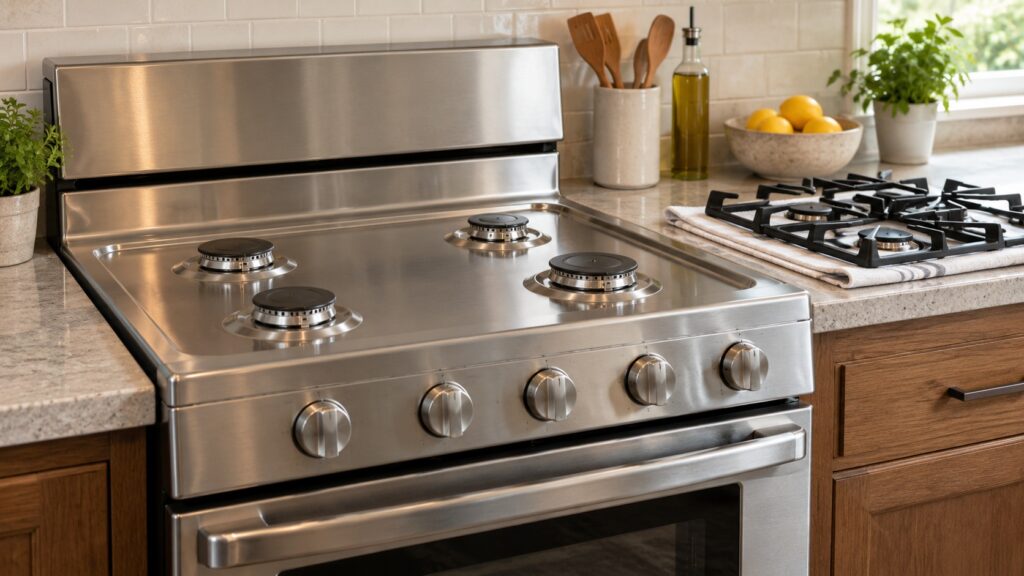
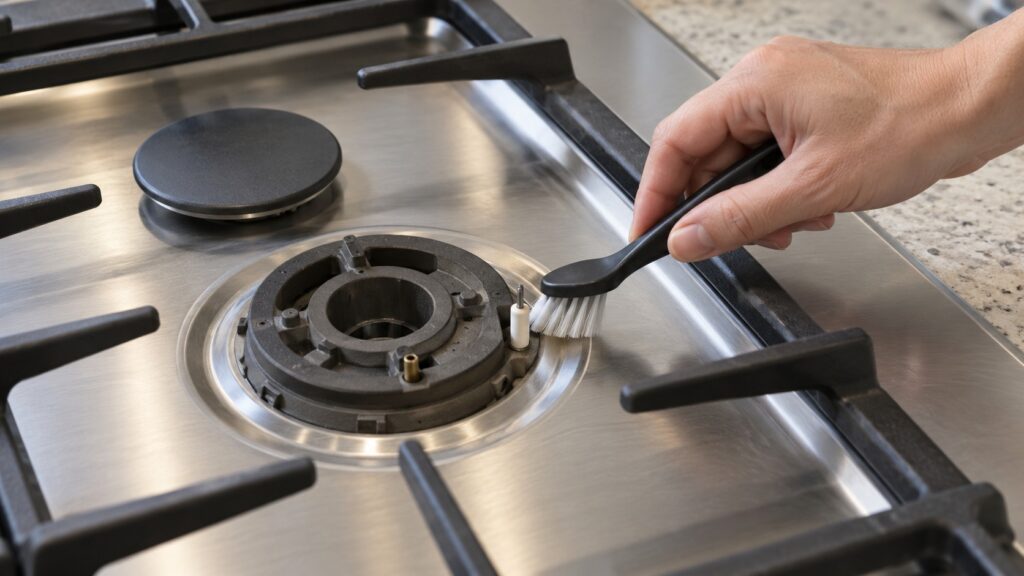
Gas burners fail to light or burn unevenly mostly because of dirt, not because a part has failed. Once a month, with the range cool and the burners off:
- Lift off the grates and the burner caps. Wash them in warm soapy water and dry them completely.
- Clear the burner ports. Use a soft brush or a straight pin to open any port that is plugged with food. Do not enlarge the holes.
- Wipe around the igniter. Brush the small ceramic igniter lightly with a dry brush or cotton swab. A greasy igniter sparks but does not light the gas.
- Refit the caps correctly. A cap that sits crooked blocks the flame, so check it is flat and seated.
When you next light the burner, the flame should be steady and mostly blue. A yellow, orange or lifting flame means a problem. Our guides to Kenmore range burner and igniter parts and a Kenmore range burner not igniting go through the causes.
How do you care for electric elements and smooth tops?
On a coil model, switch the element off, let it cool and pull it gently straight out of its socket. Wipe the drip pans or replace them if they are burnt through, and never immerse the element in water. Push it back in firmly, because a loose element arcs at the socket and fails early. On a smooth glass top, use a cooktop cleaner and a soft pad on a cool surface, and lift burnt-on residue with a razor scraper held at a shallow angle. Avoid abrasive pads. Our Kenmore cooktop maintenance guide covers the glass in more detail.
How do you look after the oven?
The oven needs four small habits.
- Protect the door gasket. The soft seal around the door keeps heat in. Do not scrub it or use cleaners on it, and replace it if it is torn or flattened, since a leaking door causes uneven baking.
- Keep the oven vent clear. Heat escapes through a vent near the back of the cooktop or below the door. Do not cover it with foil or a pan.
- Do not line the oven floor with foil. It can block airflow and damage the finish.
- Clean it before it gets bad. Wipe spills when the oven is cool, and run the self-clean cycle every few months if your model has one.
If your oven bakes unevenly, test its temperature before you blame the range. Our guide to Kenmore oven temperature calibration explains how, and the wall oven maintenance routine covers the oven side of the same job.
How should you use the self-clean cycle safely?
A self-clean cycle heats the oven far above normal baking temperature to burn off soil, and that calls for some preparation. Remove the racks unless your manual says they can stay, take out pans and foil, and wipe up heavy spills first so they do not smoke. Open a window or run the hood, because the fumes are strong, and keep pets and birds out of the kitchen. Do not use chemical oven cleaner in a self-cleaning oven. The door locks during the cycle and stays locked until the oven cools, so never force it. If the door stays locked after the cycle, read our guide to Kenmore oven error codes, since door lock codes differ by builder.
What safety checks belong in the yearly routine?
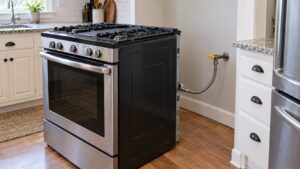
Once a year, pull the range gently forward if you can do so without straining the gas line or the cord, and look behind it. Check that the anti-tip bracket is still screwed to the floor or wall and that the range foot engages it. Look at the power cord for cracks and at a gas connector for corrosion or kinks. Make sure the range sits level, because a tilted range cooks unevenly and lets fat run to one side. If you ever smell gas, leave the house, do not use switches and call your gas utility. Our Kenmore range installation guide shows what a correct setup looks like.
When should you call a technician?
Call if a burner will not light after cleaning, if the flame is yellow or lifts off the burner, if the oven bakes unevenly with a clean seal, or if you see sparks, scorching or a code. Our Kenmore range repair technicians test igniters, sensors, elements and control boards. We are an independent repair company, not a factory service arm, and we will tell you when a repair is not worth doing. You can book a visit with the model number.