Kenmore burner clicking is the sound of the spark igniter, and this guide is about reading the pattern of the clicking rather than fixing a burner that will not light; for a burner that clicks and never lights, our burner not igniting guide has the full checks. Here the question is different: does the clicking carry on after the burner is lit, start with no knob turned, come from one burner or from all of them at once, and start after cleaning? Each pattern points at a different part, and none of the owner checks below involves the gas supply. The exact lighting steps for your model are in your owner’s manual.
What is the clicking on a Kenmore gas range burner?
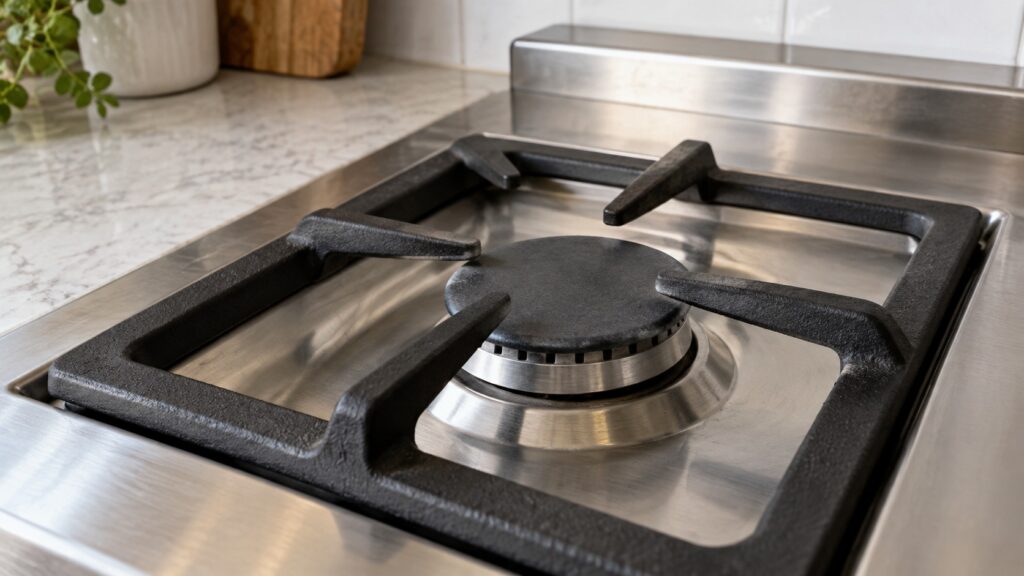
Our burner and igniter parts guide says a surface igniter is a spark electrode at each burner that clicks, sparks and lights the gas, and that all the electrodes on a gas cooktop are driven by one spark module. So the click is the system working: it is a spark, not gas. Lighting a burner is a race between gas reaching the port and the spark finding it. If the gas is not arriving properly, or the spark is going somewhere else, you get clicking without a flame. The oven in a gas range is different: its igniter is a glow bar that heats up silently, and the parts guide covers it separately.
What if it clicks but the burner never lights?
That pattern has its own guide, our burner not igniting guide, which walks through blocked ports, a misaligned cap and moisture after cleaning. The short version for this article: steady clicking with no flame is not an electrical failure by itself, because the spark is working; it is the spark that you can hear. Check, with the burner off and cool, that the cap sits flat and belongs to that burner position, and if you washed the parts recently let the range dry fully before testing again. Anything beyond that, and anything involving the gas supply, is for a technician.
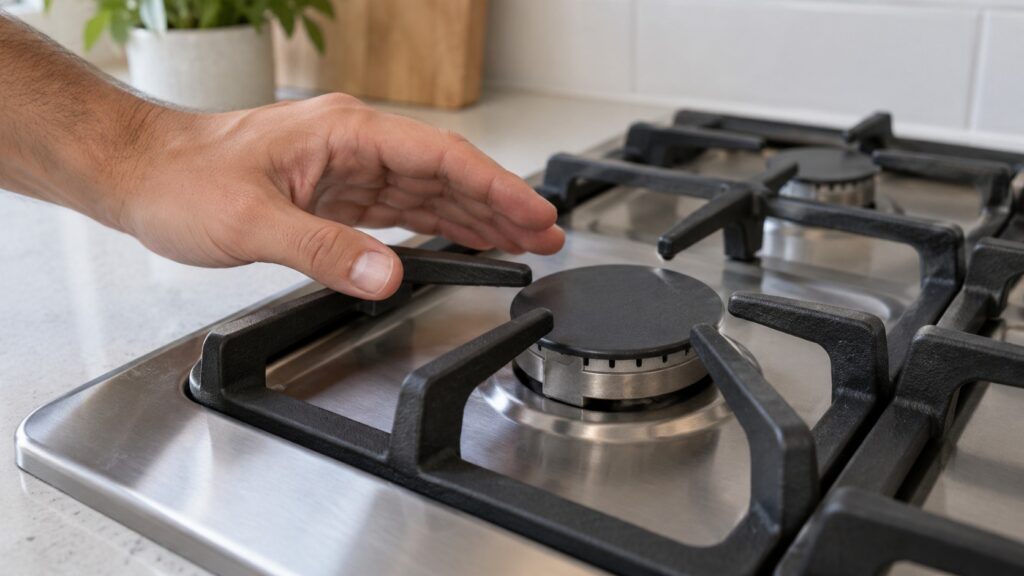
What if it keeps clicking after the burner lights, or with no knob turned?
This is the pattern on our range burner clicks constantly page. The igniter keeps sparking even after the burner has lit, or when no burner is selected. The page lists moisture in the igniter, a stuck or misaligned ignition switch under a knob, a misaligned burner cap and a faulty spark module, and says it is a low-severity problem. The owner checks are short: dry the igniter and the area around it thoroughly if there was a spill or wet cleaning, confirm each knob turns fully off and returns to its stop, and check the cap sits flat. Our parts guide says continuous clicking is almost never the module first; moisture around a switch or an electrode is the usual cause, and it clears once everything is dry.
What does it mean when one burner clicks and the others do not?
A problem on one burner only points at that burner’s parts: its cap, its ports, its electrode or the switch under its knob. The parts guide says the electrode can fail in two ways, a cracked ceramic insulator that lets the spark go to ground and food or moisture bridging the gap. It says to clean and dry it before replacing it. Do not bend or scrape the electrode. If the other burners light normally and this one still will not after the cap and port checks, the electrode or its switch is for a technician.
What if every burner clicks, or none sparks at all?
Because one module drives all the electrodes, a failure that affects every burner at once points at the module or the supply, not at four separate parts. Our parts guide says that when the module fails completely, every burner stops sparking, and when it partly fails the clicking continues after a burner has lit. Check that the range is plugged in or that its breaker has not tripped, because the ignition uses household power. Do not touch any gas valve or connection yourself. Opening the control panel or testing the module is work for a technician with gas experience, as our burner guide says.
What if you smell gas, and when should you call a technician?
If you smell gas at any point, do not switch anything on or off, do not use a lighter or match and do not try to find the leak. Leave the house and call your gas utility or 911 from outside. Never keep trying to light a burner that smells of gas, and do not test gas connections yourself. Call a technician when the clicking continues after you have dried and reseated everything, when the same burner returns to the problem, when every burner is affected, or when anything involves the gas supply, the valve, the spark module or the wiring. Our Kenmore range repair page explains a visit, and you can schedule a visit online. We are an independent repair company, not the manufacturer.